





.jpg)
.jpg)
.jpg)

So where have I gotten to three years post injury?
On some hazy day in April of 2006 I woke to discover my legs would not move. Major surgery weeks later after antibiotic therapy was initiated but seen not to be effective on it's own. Six Months over three different hospitals. Could not sit up at all - would flop over at the waist like a rag doll. Lifted from bed and chair with sling and hoist. No movement below lower chest, no pain (after initial surgical incisions) Catheterized. Left rehab hospital in about that state with only the slightest movement returning to my legs - which I decided not to share with hospital staff because of a disinterested if not negative attitude. Two doctors dryly stated that I would never walk again.
Returned home at the end of October of 2006 in about that state. Hospital bed in the living room, hoist, etc. Community health care sent me an in-home physiotherapist who assessed me and felt some flicker of movement stating "we can work with this". In January of 2007 I suddenly realized that I sat up with some abdominal control while reaching for something. As the inflammation continued to recede, the mobility slowly increased but the amount of neurgenic leg pain increased with it. The bad came along with the good. Post injury, through this period, I had massive spasms where one leg or the other would begin jerking uncontrollably, one or the other (never both at once, hmmmm?) and the would be violent and last sometimes for hours.
Started physiotherapy 4 times per week at my local community hospital (hospital number four). After a few months one gym session was replaced with pool therapy.
Got fed up with bowel treatments and catheter bags after the first year and got rid of them. Those functions have returned to near normal.
Continuing physiotherapy over the next few years, strengthening whatever muscles had returned under my command. During this time I was fitted for long braces (KAFO) which had a locking hinge at the knee. Put them on and wobbled in the parallel bars further strength and balance. Progressed to braces below the knee (AFO), with a limited hinge at the ankle. Each progression took about a year (a year from exercises on a mat to a sit-to-stand frame, another year to progress to walking with long braces, another year to walking with the short ankle braces, to now walking distances with braces and walker.)
Paralysis is only some 50% of the problem. The other major problem continues to be the intense and constant neurogenic leg pain (pins & needles/burning). The spinal nerves are permanently damaged and are continuously sending the signal that something is wrong and to stop it - only it can't be stopped.
Drugs have little or no effect on this particular type of pain.
Spasms have reduced to a few mild ones, usually late evening and not lasting for very long.
BoTox therapy could not be felt internally in any way but did improve my gait as the stride seemed to be longer and better controlled - that is, foot went right where I wished to place it rather than perhaps drift a bit or pull in to center. BoTox may have lost it's effectiveness about 3 weeks prior to my 4 month post-injection assessment and probable repeat injection.
In spite of the intense core exercises I still feel as if My middle is wrapped in a large Theraband (elastic band). Muscles are very tight and don't want to give at all. Doesn't hinder any motion or breathing but feels uncomfortable.
Muscular control has returned to much of my legs but the dorsiflection (lifting my foot off of the ground with heel in contact with the floor - or cannot tap my foot on the floor as I can push down but not pull up)
Post injury the muscles or back were altered such that I developed an intense sciatic nerve pain which manifested itself as an intense pain in the left seat/butt/hip joint area, making it hard to sit for any length of time. Turning on my side or back doesn't help much as even each pulse of circulating blood causes the spot to throb. The pain often manifests itself in the left heel at the same time. The most recent core exercises seem to have helped with this pain as it feels less intense, and occurs less frequently. Some days good, some not so much but can't correlate the change with 'post-exercise' fatigue, length of time sitting, weather, barometric pressure etc.
So in summery, I went from a catheterized rag-doll stuck in one position to now where I can turn to sleep in any position on my bed, dress myself and leave home for appointments without assistance. While my neurogenic leg pain remains intense and very distracting, other symptoms have improved immensly and I can walk with a fairly normal gait with the assistance of a walker. Distances are limited but are improving week to week. Transfering to a car or van is no problem as I can stand and swivel into the seat and lift my own legs into the car under their own muscle strength and control (no transfer board). Lyrica medication does not seem help the nerve pain much, if at all but one of the side effects is weight gain and I believe that side effect may be manifesting itself on me, which is problematic as I'm a big guy anyways.
So, I'm walking ever increacing distances but nerve pain remains the most distracting symptom.
Monday, 31 August 2009

Friday, 28 August 2009
End Of OHIP Funded Physiotherapy
Today was the final day of my 16 weeks of OHIP (Ontario Hospital Insurance Program) funded physiotherapy.
Took the walker around the hospital hallways for an extended walk. Seemed a bit more sluggish since one week ago. Stride not as long or as smooth. May be that the nerves have regenerated and another course of BoTox is warranted. Due to be assessed in early September.
Now its up to me to keep up the exercises and walking schedule and/or find a private physiotherapist in the community who might take over and suggest other exercises, procedures, therapies, or whatever, that might help advance my recovery.
Starting back to work in September - will certainly cut down on available time.
***As an afterthought, I finished my physio routine as below
A final exercise is done on the NKO (?) bench which is simply a seated bench where each leg can lift weights up in a gentle kicking motion (quads) or adjusted to fight the weights when pulling back (hamstrings) - again 3 reps of 10 though I continue on until my therapist finds time to take me off. If any time remains (about 1 hour & 30 minutes at this point), I return to the parallel bars.
So those are the excercises I perfomed on my last weeks of therapy.
Took the walker around the hospital hallways for an extended walk. Seemed a bit more sluggish since one week ago. Stride not as long or as smooth. May be that the nerves have regenerated and another course of BoTox is warranted. Due to be assessed in early September.
Now its up to me to keep up the exercises and walking schedule and/or find a private physiotherapist in the community who might take over and suggest other exercises, procedures, therapies, or whatever, that might help advance my recovery.
Starting back to work in September - will certainly cut down on available time.
***As an afterthought, I finished my physio routine as below
- arrive and stretch out at parallel bars to loosen muscles, tendons and joints which seem to contract overnight much more than pre-injury. Walk up and down a number of times.
- walk with the walker in a longer hallway outside of physio. About 60 meters up & down each rep. Do two to three reps usually, as time allows, but now near the end of my sessions the walk was taken right out of the department taking various twists and turns while on different floor surfaces (terrazzo, carpet, tile etc.)
- return to physio to do various bench exercises currently focusing on the body core and it's contribution to stability and walking. On all fours raising one arm straight out then alternating with the other. On all fours again but now kicking one leg straight out the back, then alternating with the other. On my back pressing a rubber ball with my right hand into my left thigh, then reversing sides, left hand into right thigh - strengthens obliques. With large diameter ball (~1.5') under my heels, I pull my heels in and roll the ball towards me then out again, repeating. Then with the same ball under the back side of my knees, I bridge, lifting my back up off the mat with just my shoulders touching. A final exercise is seated, then lifting a weighted ball (~3/4' dia) from my lower right side slowly in an arc up to my upper left side, while twisting but keeping my back straight. Then reverse.
A final exercise is done on the NKO (?) bench which is simply a seated bench where each leg can lift weights up in a gentle kicking motion (quads) or adjusted to fight the weights when pulling back (hamstrings) - again 3 reps of 10 though I continue on until my therapist finds time to take me off. If any time remains (about 1 hour & 30 minutes at this point), I return to the parallel bars.
So those are the excercises I perfomed on my last weeks of therapy.
Thursday, 27 August 2009
This & That-More Bitching!
Pain - still trying to decide if the Lyrica has any appreciable effect on my nerve pain at the dose I'm taking. Thought there may have been a slight reduction at first but most of the time it's still intense enough to divert my attention to the pain every few minutes. Hard to put it out of my mind. No noticeable side effects at this dose, except perhaps occasionally blurred vision. May just be fatigue.
Insurance - my insurance company responded to my submission of the $1G+ bill for the joystick with their usual confusing statement.
If I have fire insurance for my house and it burns down, do I have to rebuild it with my own money and then submit it to the insurance company to see what portion they'll reimburse after my rebuilt house is paid in full??? Of course it is all how the policy is written but it is clearly designed to discourage eligible people in need from collecting on the policy. The CEOs need their bonuses and the greedy disabled are siphoning off funds!
*I've previously received a statement from this insurance company which read something like 'the item is covered 100% for the usual and customary coverage in your area'
-translating this bafflegab, it says something like 'of the charge you submitted, we may cover only about 10% of the expense but we cover 100% of that 10%.....Huh????
So, the joystick is covered but how much is unknown until I submit an invoice saying it is "Paid In Full". So, after inquiries, I have no idea of how much I am on the hook for. Sure doesn't give me the "piece of mind" the insurance companies try to sell you with all their excessive TV ads!
Return to Work - Finally, almost exactly one year to the day I started looking into returning to work, I have a return date set for September 8th. This year long process required;
Insurance - my insurance company responded to my submission of the $1G+ bill for the joystick with their usual confusing statement.
- "The estimate for this expense is approved. Please remember that the actual amount payable is subject to plan coverage limits and deductible that are applicable. To be eligible for payment, the expense must be incurred while covered under the plan. We will assess the claim when we receive a receipt showing the expense is paid in full."
If I have fire insurance for my house and it burns down, do I have to rebuild it with my own money and then submit it to the insurance company to see what portion they'll reimburse after my rebuilt house is paid in full??? Of course it is all how the policy is written but it is clearly designed to discourage eligible people in need from collecting on the policy. The CEOs need their bonuses and the greedy disabled are siphoning off funds!
*I've previously received a statement from this insurance company which read something like 'the item is covered 100% for the usual and customary coverage in your area'
-translating this bafflegab, it says something like 'of the charge you submitted, we may cover only about 10% of the expense but we cover 100% of that 10%.....Huh????
So, the joystick is covered but how much is unknown until I submit an invoice saying it is "Paid In Full". So, after inquiries, I have no idea of how much I am on the hook for. Sure doesn't give me the "piece of mind" the insurance companies try to sell you with all their excessive TV ads!
Return to Work - Finally, almost exactly one year to the day I started looking into returning to work, I have a return date set for September 8th. This year long process required;
- mounds of paperwork filled out - filed or to retract other forms filled previously
- doctor's assessment and approval ($120.00)
- 2 hour in home interview which covered topics such as how many rooms I had in my home and what did I have for pets (what the *&$%# does this have to do with my returning to a job I still held?)
- Bean counters and number crunchers at the Insurance Firm ruled that since I want to return to work, they no longer considered me disabled and came up with the date of April 3rd for me to get back to work for on that date my disability pay would cease. It did and I've been coasting on savings and family charity ever since.
- had an 'on-site' ergonomic assessment including photographs and measurements. Although my problem is that I can't yet walk independantly, the morons recommend that I need an ergonomic computer keyboard. Don't use one at home, my hands/arms are fine, why?
- Improper informatiion from my regulating college meant I had to take a refresher course to return to a profession I've been in for 30 years. Crammed a $350 36 week course into just under 5 weeks.
- Dealt with some unhelpful people at my regulating college to regain my 'practicing status'
- Interview with Human Resources, Occupational Health (2) & Department Director regarding various matters including safety measures. (how to get me out if the department burns down)
Thursday, 13 August 2009
If It's Medical....MARK IT UP!!!!$$$$$$$
$$$$$$$~If It's Medical....
MARK IT UP!!!!~$$$$$$$
MARK IT UP!!!!~$$$$$$$
My electric wheelchair's charge is running low so as is my routine, I plug it in at night so it will get a full charge in some 8 to 10 hours. However, next morning the indicator shows only a partial charge. Investigating, I plug in the chair once more and notice the fault light come on the remote charging unit and it promptly shuts down. I call the company (different supplier than my manual chair) and describe my problem to a pleasant customer service lady in the service department. Soon thereafter I get a return call from the actual service technician and I describe the problem to him once again, in greater detail. Told me he would be right over.....and he was.
I had dealt with this service person before and have found this young fellow very pleasant, polite, helpful and knowledgeable. A real treat to find someone who bends over backwards to be helpful, is polite and exudes competence!
That said, I was shocked to find out that the problem lies not with the charging unit but in the small, almost palm sized controller with the joystick attached. The charging plug is located on this unit and the circuitry regulates the charging of the batteries. The shock (no pun intended) was not that this electrical controller was at fault but rather that the replacement price for a new unit is $1120.00. Now, for over a grand, I can buy a completely loaded laptop computer, a audiophile stereo component or perhaps some lackey to physically carry me around for a couple of weeks.
 The joystick control & charging unit that is priced at $1120.00
Anyways, the usual scenario follows - a call is placed to my private health care insurance carrier and after the usual 'phone tag' , the customer service person doesn't know much. On hold while consulting supervisors. Returns to phone but still unresolved. Instructed to send in an extended health claims form, a copy of the original doctor's prescription for the chair and a copy of the repair invoice. That done, I wait, knowing that it has taken about 3 weeks for them to reply in the past. I'm not getting my hopes up, also from past experience.
My beef is with the industry and the inflated prices because this is technically a 'medical' item and that every supplier has $$$$ in their eyes thinking that all will be covered by some insurance (and they want their take) or that you've had some huge legal settlement (and they want their take),
The repair technician has bent over backwards to help and may have a few tricks up his sleeve.
In the meantime, I'll be waiting patiently for the insurance companies ruling.
More on this as it unfolds....
Saturday, 25 July 2009
Ouch!!!!!!!!!!!!!
May have blogged too soon. Seems that within a week's time, the sharpened points of a million No. 4H Eberhards are back! At times hovers between 7 & 8 on a scale from 1 to 10 with the agonizing burning pins & needles nerve pain back below the knees to the toes. Arrrggghh!!! Seems like Lyrica at my dose does squat.
Monday, 20 July 2009
Some Pain Relief?
Some Pain Relief??
Having replaced Gabapentin for Lyrica two days ago, I believe there may be some reduction of neurogenic pain. Where previously my legs below the knees felt like they were being repeatedly stabbed by thousands of sharpened pencil points, now I get the same sensation but as if I'm being stabbed with the eraser end of the pencil. The intensity remains but the sharpness of the pain is reduced. Still annoying but at this point I'm happy for any degree of relief.So far too, I have not noticed any of the extensive list of side effects that Lyrica may induce.
If this remains the case, I shall ask my doctor to increase the dosage next time I require a prescription renewal to see if the pain sensation can be further reduced.
 Which end would you rather be stabbed with 24/7/365??
Saturday, 18 July 2009
Neurogenic Pain Treament Change
Treating the Untreatable
Neurogenic Pain
It was both a blessing and a curse when in January of 2007, I was reaching for some item in front of me and I realized that my torso actually angled forward. Previous to this, my injury had rendered me a virtual 'rag doll' from the chest down. Now, as the inflammation subsided, signals were beginning to flow again and muscles started to receive more and more signals. Muscles and limbs began to move, even if ever so slowly and weakly. The upside of this increase flow of signals was muscle movement, however the downside was pain. Nerves that send impulses to muscles to make them move, but also send sensory information such as tactile (touch), proprioception (position of limb in space) and, of course, pain.
With physiotherapy much of my muscle strength and action returned. Again, after being paralyzed from the chest to toes, I now have limited action only at the ankles and below. Pivoting my foot downward at the ankle (plantar-flexion) is quite strong, however the opposite, pulling my foot upwards (dorsi-flexion) is very weak. Lateral stability at the ankles is also reduced (feet may wobble or tilt at the ankle with reduced control)
But this post is about pain. It was the signals of pain that started in January 2006 and quickly increaced to a level that hovered between very annoying and excruciating. A constant sensation of a mix between quickly fluctuating "pins & needles"that quickly and repeatably stab and "burning" sensation as if your legs were immersed in very hot water. For me it occured just below the knees and extended to the toes. There would be some fluctuation up or down and in intensity, but for the most part I burned 24/7 from the knees down. So intense that it takes your concentration away ever few minutes as your mind drifts from the task you're doing to acknowledging the pain. Hard to enjoy a book, watch TV or concentrate at your job.
While at the rehab hospital, I was prescribed 300 mg of Gababentin (Neurotonin) three times a day. As my nerve signals were still not getting through at that point I felt no pain. On my discharge in the end of October 2006, I had the hospital discontinue this medication. In January of 2007 when the neurogenic pain revealed itself, I asked my family physician to re-prescribe the Gabapentin once again. I started taking it immediately but really felt no relief. This continued right through to this week. Didn't much help, but I continued taking it as I felt I was doing something to eliminate the pain. No relief and no noticable side effects. I could just as well have been taking a placebo.
I had heard about Lyrica (Pregabalin) on several occasions - from my physiotherapist, from the physiatrist administering BoTox, and some other health care providers. About a year ago (2007), I had asked my family physician about it but he was unfamiliar with the drug. On a quick consultation with his CPS (1), he dismissed it as having too many unpleasant side effects. So that was that...
The pain remained intense and distracting and in desperation I approched him again, intending to insist of trying it. This time, without hesitation or consultation, he wrote out a script for the medication. Strange!!?? I told him that, because of the side effects (discussed at bottom), I would like to start with a smaller dosage and work up if it offered any relief and I could tollerate the drug. I began taking 50 mg of Lyrica three times a day yesterday (July 17th, 2009). Only after one day, I wonder if the sensations are somewhat muted or reduced. Still too early to tell. So far no evident side effects other than perhaps some drowsiness shortly after taking it.
Although nothing will eliminate the pain, I do hope this drug would take the intense edge off and make life bearable again. It's hard to live a joyful, pleasant and productive life with your legs immersed in boiling water year round.
I continue to take the Nortriptyline (25mg at bedtime) for nerve pain but I feel it has little if any affect at all. Perhaps I may ask that be discontinued at some later date to reduce this biochemical soup in my system.
The side effects of Lyrica can include, dry mouth, blurred vision, drowsiness, allergic reactions and edema (swelling of hands and feet) , weight gain and possible increaced suicidal thoughts. This is not a complete list of side effects but some of the more common ones encountered.
(1) CPS - Compendium of Pharmacutical Specialties - a book compliling information on all the drugs available for use by doctors including information on use, dosage, side effects, contradictions, biochemical structure, pharmacokinetics (how it works), manufacturer etc, etc.
Monday, 13 July 2009
Case-Cost Studies & Healthcare
Case-Cost Studies
(How To Take The Care Out Of Healthcare)
As mentioned in a previous post, in a a rather misguided move to save my hospital money, the management closed the 'self-pay' outpatient physiotherapy service (which brought outside money into the hospital) and moved me over to the OHIP(1) or government funded physiotherapy service which is funded by the Ontario taxpayer. In other words, in an attempt to save the Ontario taxpayer money, they switched me from private insurance covered therapy to Ontario taxpayer funded therapy. Go figure!!
I'm sure the Ontario government (or Health Canada) did numerous studies requiring numerous consultants putting in numerous hours of overtime crunching numbers in order to develop cost-case data. These cost-case studies refer to the nature of patient treatment, number of hours of therapy, length of hospital stay and maximum number of hours to be invested etc. in any particular ailment, injury or disease encountered by the appropriate health care facility and it's personnel.
If, say you had a stroke, you would be entitled to x-hours of therapy, only a, b and possibly c drugs, and, oh, 4.76 days of inpatient hospital stay followed by no more than 'y' weeks of outpatient physiotherapy. No more..... but possibly less!
The algorithm has been established by highly paid bean counters, number crunchers and paper pushers in order to establish "appropriate therapy" for the "average patient".
But is there an "average patient"? We are all different with different levels of initial health, different prognoses and responses to therapeutic drugs as well and other therapy. Should each patient not be followed carefully, observing their response to treatment an have it adjusted accordingly, even if some therapy may be unconventional? Should therapy on a non-responsive patient be terminated sooner or should therapy be modified or perhaps extended. Should it not be the goal of any health care facility and the government funded care to restore a person to as close to a healthy and productive state as possible, rather than cut them loose after, say, a hypothetical 12.23 weeks of treatment? Should a patient making significant progress be cut loose after those same 12.23 weeks even though additional treatment will benefit the patient further?
We citizens are not all the same, cut by the same cookie cutter mould, nor should the health care offered be cut by that same mold.
As in my case, it would seem that having me return to a state of health & mobility where I can return to work, earn a living and pay the government my taxes far preferential to having me sit at home on welfare or disability payment. My government should be encouraging health care facilities to do whatever it takes to restore me to a productive state. That would save money in the long run rather than trying to save on the administration of healthcare.
That said, OHIP allows me to receive 16 weeks (max) of physiotherapy after which time I am cut loose regardless of my needs or progress. No ifs, ands, or buts....
My 16 weeks will run out in this upcoming August after which I'll be on my own.
After my initial injury I was told at discharge from the hospital that I'd never walk again. I began receiving physiotherapy 2 to 4 times weekly which has continued for over two years now. I've progressed from having to be hoisted around on a sling to where I can walk unassisted with a walker. I am continuing to improve although the pace is slow.
Imagine if I only had our Canadian Socialized medicine to rely on as administered by OHIP? I would have been discharged as a useless immobile lump after 16 weeks. Goodbye - have a nice life! Luckily, through my workplace, I had supplemental private insurance and luckily they had stubbornly negotiated unlimited physiotherapy. It is only because of that that I have a chance of being independently ambulatory in the future.
How many of us citizens rely totally on OHIP for our healthcare? How many are rich enough to purchase whatever additional therapy we might need with our own savings? How many have supplemental private insurance through our workplace or are astute enough to purchase private insurance coverage when healthy in anticipation of something which we feel will never happen to us? Such a delicate safety net separates us from the hard reality of chronic illness or disabling injury.
Come some date in August I shall be on my own regarding my continuing recovery and progress or I can return to my private insurance for therapy at some private (for profit) clinic in my community.
We in Canada would like to believe that we are compassionate, extending healthcare to those in need, however it is measured and meted out in pre-determined doses at the discression of the government.
(1) OHIP - Ontario Health Insurance Program (Socialized Medicine)
Thursday, 4 June 2009
BoTox Assessment - Post Injection
BoTox Assessment - Post Injection
A follow-up assessment 2 weeks post therapy indicated that there was significant change in the amount of spasticity allowing increased flexibility at the ankle. I didn't get a full grasp of the indicies and terminologies used but in plain English, the treatment eliminated all measurable spasticity. Yet with this loss of muscular tension I still lack in the ability to initiate dorsiflection (pull up with my foot at the ankle). Again, as I mentioned in the previous post, my physiotherapist felt that I was taking longer strides when walking with the walker. The physiatrist (doctor) administering the BoTox was pleased with the physical results as well as my stride/gait when walking with the walker in his hallway.
From the inside-out, so to speak, I feel no difference physically. If others didn't observe differences in my walking, I wouldn't have been able to tell the difference pre or post injection. I could flex my foot up and down (plantar & dorsi flection) before and can still do so. Plantarflection has always been much greater than dorsiflection when I initiate the motion, however the therapy has probably loosend the muscular tension allowing greater range in the dorsiflection. Although I can't pull my foot up to any significant degree, the extra 'passive' flexability allows me to stand a bit straighter without being pushed backwards which allows for a better walking gait.
As all measurable spasticity (tension) was eliminated in the targeted muscles, no further injections were scheduled and I will be reassessed in early September of 2009 as by that time the nerves may have regenerated and a follow-up (ongoing) injection(s) may be necessary.
 Botulinum Toxin (Injectible)
Thursday, 28 May 2009
Botox Therapy - Initial Treatment
Botox Therapy - Initial Treatment
 Just over one week ago I received my first treatment with Botulinum Toxin (BoTox). The initial treatment of 5 injections per leg totaling 300 units of toxin. The gastrocnemius (gastrocs) and soleus muscles were targeted in hopes of reducing spacicity and tighness and improve my walking gait. The tightness pulling through the achillies always tried to keep my heels off of the ground even when standing. This was visable when walking as my heels could be seen rising up and out of my running shoes with each step I took. My hope was to improve on this action which might then translate to a better (upright) posture throughout my body.
 Just over one week ago I received my first treatment with Botulinum Toxin (BoTox). The initial treatment of 5 injections per leg totaling 300 units of toxin. The gastrocnemius (gastrocs) and soleus muscles were targeted in hopes of reducing spacicity and tighness and improve my walking gait. The tightness pulling through the achillies always tried to keep my heels off of the ground even when standing. This was visable when walking as my heels could be seen rising up and out of my running shoes with each step I took. My hope was to improve on this action which might then translate to a better (upright) posture throughout my body.
Nerve endings blocked by Botox are permanent however peripheral nerves do regrow forming new pathways (circumventing the old bocked nerves) and the therapy must be repeated in approximately 3-4 months.
Injections were virtually painless and over in about 15 minutes.
After this first treatment, no ill effects were noticed nor was there any real noticable effect seen nor felt after one week post injection. The Dr. administering the treatment said that the toxin would take effect between 1 and 7 days post injection.
That's not to say there is no effect - just that I haven't personally noticed it either visually or through sensation. First thing in the morning as I place my feet on the floor and press down, I can feel a tension and tingling up the achillies as I press my heels to the ground. I'm using this tension and sensation as my guage in measuring the effacacy of the therapy. Perhaps my expection is misguided.
However, within 24 hours, my physiotherapist observed that I am taking longer strides with each step, so it appears that there is some benificial effect.
This, of course, is the initial treatment. It's my understanding that the doctor will assess the changes and adjust therapy accordingly. He spoke about videotaping my stride (walking with walker) over the course of the therapy in order to compare the changes over time and assess the progress.
Next appointment is two weeks post therapy for to assess effectiveness and adjust dosage and frequency of subsequent injections.
Again, 300 units from one vial was used in the initial injection at about $400-$425 CND per vial which is covered 100% by my private insurance.
Injections were virtually painless and over in about 15 minutes.
After this first treatment, no ill effects were noticed nor was there any real noticable effect seen nor felt after one week post injection. The Dr. administering the treatment said that the toxin would take effect between 1 and 7 days post injection.
That's not to say there is no effect - just that I haven't personally noticed it either visually or through sensation. First thing in the morning as I place my feet on the floor and press down, I can feel a tension and tingling up the achillies as I press my heels to the ground. I'm using this tension and sensation as my guage in measuring the effacacy of the therapy. Perhaps my expection is misguided.
However, within 24 hours, my physiotherapist observed that I am taking longer strides with each step, so it appears that there is some benificial effect.
This, of course, is the initial treatment. It's my understanding that the doctor will assess the changes and adjust therapy accordingly. He spoke about videotaping my stride (walking with walker) over the course of the therapy in order to compare the changes over time and assess the progress.
Next appointment is two weeks post therapy for to assess effectiveness and adjust dosage and frequency of subsequent injections.
Again, 300 units from one vial was used in the initial injection at about $400-$425 CND per vial which is covered 100% by my private insurance.
Monday, 18 May 2009
Comments Made On This Blog
There are a few comments and inquiries made on this blog and my injury. For whatever reason, I did not receive notification by Blogger that they were added and therefore did not reply.
I apologize to anyone I did not answer as I probably did not get your message at all or in a timely manner. I have not ignored any legitimate questions on purpose and those wishing to inquire again - I will try to respond.
I apologize to anyone I did not answer as I probably did not get your message at all or in a timely manner. I have not ignored any legitimate questions on purpose and those wishing to inquire again - I will try to respond.
Sunday, 17 May 2009
BoTox Therapy
BoTox Therapy
BoTox or Botulinum Toxin therapy has been suggested as an adjunct to my physiotherapy. The problem lies in the stiffness in my feet and achillies. The release of acetylcholine keeps nerve muscle synapses contracting and has my muscles/joints tight. Stretching out has little effect in releasing the tightness for any period of time. Botulinum toxin permanently disrupts the signal transmission to relax the muscles however, unlike the spinal cord, peripheral nerves can regrow and in time new connections will re-grow and transmit the signal once again. Repeat injections may be necessary. With the therapy I should be able to stand upright better, at 90 degrees to the floor and not be pushed backwards because of tight muscles not allowing me to lean forward efficiently.
I figured that a micro-organism (Staph aureus) got me into this mess, perhaps another organism (Clostridium botulinum) producing BoTox, may get me out, if even a little bit.
I made an appointment some two months ago for an evaluation with a Physiatrist (Physician & Therapist) and he thought that I was a good candidate for such therapy. All I needed was approval from my health insurance carrier. I had phoned the insurance company some time previous at which time after playing phone tag and sitting on hold for about 15 minutes, I was verbally informed that I was covered for such treatment.
The doctor personally required this information prior to starting therapy so I filled out a form in his office and it was faxed off to the insurance company that day. Since that time (6 weeks+) neither I nor my doctor's office received any reply from the insurance company. Now I have to play phone tag with their customer service reps once more to find out what happened. My doctor's office insists the form would not be sent to their office but should be sent to me at home. The reason?
Patient confidentiality!
I authorized my doctor to inquire about therapy coverage from my insurer and they can't tell my doctor because of "patient confidentiality". Pretty soon they won't release information to the patient because of patient confidentiality.
At about $400 per vial, I can't afford to get this therapy out of pocket unless I know I'll be reimbursed. Unless I have it in writing, I don't believe anyone anymore.
Attempt To Return To Work
Attempt To Return To Work
(Including Regaining My Professional Practising Status)
(Including Regaining My Professional Practising Status)
Late August 2008:
So what could go wrong? I'm bored to death and LTD (Long Term Disability) income sucks so perhaps now is the time to return to work.
My Doctor's eyebrows raised when I informed him I'd like to return to work. Really?
I need a 'Return To Work' form signed by him in order to proceed.
Approached Human Resources at my workplace but they tell me Occupational Health handles any return to work issues. I motor down to Occupational Health and speak to them about returning to work. No! - return to work requests have to go through my Private Insurance Carrier, not my employer. So I contact my Private Insurer about returning to work. Unlike my claims reimbursement submissions which take weeks to be acted upon, I had a date set for an interview shortly thereafter.
The Interview: Did not expect this. A two hour interview on issues such as "what pets I have" and "how many rooms I have in my home". Now, if I had a pet monkey and lived in a one room dwelling, I can't see how that would be important in my returning to a job that I still have. I didn't have such an extensive interview on applying for the job in the first place, some two decades ago.
More forms and papers passed back and forth for signing.
As I am employed as a medical technologist in a hospital lab, my skill is 'licensed' by a regulating college. When I first came home after my injury I called the college and placed myself on 'non-practising' status as it was not only truthful but cheaper in these monetarily challenged times. My college informed me that I can switch to non-practising for a period of two years and then return to practising without any consequences. What they failed to tell me at that time was that if I didn't reach the magic number of 900 hours worked in the previous year, the year would count as zero hours, or not worked at all. I was just under so that year didn't count.
So when I tried to regain my practising status I was now informed that after 30 years in the business, 20 of which at the same job with the same employer, I was a few hours short and had to take a refresher course. Because I am still dependent on a wheelchair, I couldn't commute and needed something offered by correspondence. Two courses met my requirements and that of the college but one course was 5 hours short of the 60 hours the college stated I needed and they wouldn't bend on the issue.
After 30 years of employment 5 hours separated me from regaining my practising status!
Well I chose the other option and after some difficulties in getting registered I was enrolled in the refresher course rated at 80 hours, over 36 weeks which arrived in three 3 inch binders.
I took this issue seriously and crammed my 36 weeks into 4 strait weeks of studying. As I was familiar with most this material, it wasn't too difficult.
After 30 years in the discipline, asking me to take a basic refresher was akin to having an executive secretary returning to the workforce take a course on which is the business end of a pencil and what is a computer keyboard.
The refresher course was tested with 10 one hour exams which I wrote in three sessions and in about 5 hours. Now I'm waiting for the marks to arrive so I can forward them to the college for reinstatement.
Ergonomic Assessment:
I did have an ergonomic assessment at work to see how I could physically fit in to the lab. I felt I had very few problems. I wanted as few changes as possible as this was the real world and I could adapt or figure out how to do some task or reach particular items. Unbelievably, the assessor had me reach for various items while she took measurement of my arm to the item, of the item to the floor etc. Then the same was documented in photographs, Thorough!
Now, the only difference pre and post injury is that I am unable to step away from the wheelchair without a walker, why on earth do they want to get me an ergonomic computer keyboard? My hands and my reach are unaffected! Go Figure!
So, I've jumped through all the hoops and all I have to do now is to wait for my marks, forward them to my college and inform the Occupational Health Department of my status.
If the past holds true, I'm certain more obstacles will find there way into my path.
So, I started inquiries about returning to work in August of 2008 and now it's May of 2009.
My attempt to return to a job that I still have has taken about 9 months so far.
Thursday, 2 April 2009
Accupuncture
Acupuncture & Massage Therapy
In an attempt to loosen the tightness in muscles and joints the physiotherapist tried acupuncture. During several attempts she found that my muscles were so tight/hard that she couldn't get the needle in without bending it. Holding it closer to the point so it wouldn't bend would compromise sterility. Shorter needles didn't bend but were less effective.
After four half hour sessions, no appreciative difference was noted and the therapy was discontinued. BoTox therapy may accomplish what acupuncture could not. That has yet to be seen.
My private insurance had allowed payment for 6 one hour massage therapy sessions. I took advantage of this on the advice of my physiotherapist, again in hopes of releasing tension, particularly in my calf muscles but also the ham-strings and even possibly help the sciatic pain. The masseuse commented that my calves "felt like baseball bats" - hard. After six sessions he felt they were more supple and helped somewhat in movement. It sure felt good but I'm not sure how much effect they had on me.
One problem associated with this injury and the inability to continuous walk is that the muscles tighten and as they do they apply pressure on the blood vessels thereby reducing circulation. The massage therapy may have aided circulation.
Wednesday, 1 April 2009
Long Term Disability Income
Long Term Disability Income
The moment I expressed an interest in returning to work, my private insurance carrier broke into cheers and deemed that I was no longer disabled therefore my Long Term Disability Income (LTD) was to be terminated. As Of April 3rd, I will no longer have any LTD money as income and as it is my only source of income, I'll be coasting on whatever I have left after paying off the $6300.00 wheelchair.
(I guess I can roll down to the street corner and sell pencils from a tin cup in the interim.)
The next post is all about my efforts in returning to my workplace.
Continuing Physotherapy
Continuing Physiotherapy
In Ontario Canada, because continued stress on our health care resources, our provincial government has created an agency/board/ (?) entitled the Local Hospital Integration Network (LHINs) which for all intents and purposes, relieves the government itself of making difficult decisions regarding reorganization and cuts to health care. As a result they decided that the outpatient physiotherapy department at my hospital is redundant with those private clinics in the community and the money making unit was ordered closed. As I'm an employee of that hospital, it would have been convenient for me to attend when I return to work. With it's closing I was to find a physiotherapist in the community. I have to question whether those clinics in the community are more accustomed to treating sports injuries and motor vehicle accidents rather than more serious brain & spinal cord injuries. I'm sure there are many fine clinics out there but do they have the turnover of serious conditions and injuries to become experts at such specialized treatment?
I am not being offered pool therapy on the OHIP physiotherapy clinic. Told that pools are available at community centers, however they don't staff physiotherapists to suggest exercises and correct technique. Pool therapy and water buoyancy helped in regaining strength and balance.
Perhaps because I have been in the hospital physiotherapy program for such a long period of time, perhaps because I'm an employee and colleague, perhaps it's my dazzling personality (yeah, sure), perhaps they tried to accommodate everyone this way but after the outpatient department closed, they transferred me to the OHIP (Ontario Hospital Insurance Plan) side of physiotherapy which remains at the hospital.
So try to understand this - in order for the government to save money, I was transferred from the 'self pay' and income generating outpatient physiotherapy side to the OHIP, government paid side of physiotherapy. Now, to the delight of my private insurance carrier, the premiums of which my employer (the hospital) pays into, no longer is billed for my therapy but rather the Ontario Government and ultimately the taxpayer is paying for my continued therapy. Makes sense only in the mind of a politician/bureaucrat.
So I'm continuing physiotherapy on the taxpayer's coin rather than the private health care insurance which I'm entitled to.
The usual duration of OHIP physiotherapy is 16 weeks max from what I understand so I may be looking for a new physiotherapist and a new clinic sometime in the near future. As it will be off site, it will an additional inconvenience for me.
So, with each change I get a new physiotherapist, with a new interview/evaluation as they learn about me, my injury, my abilities, my needs etc. Those interruptions result in delays in actual physiotherapy and some frustration.
In Summary, physiotherapy continues but now at twice a week with no pool therapy. Most physiotherapy now consists of a warm up at the parallel bars, a walk up and down the hallway (~360 meters/yards) per day and then bench exercises to strengthen the core muscles.
Sunday, 29 March 2009
Progress at Three Years Post Injury
Progress at Three Years Post Injury
Three years ago I had a Staphylococcus aureus infection on my spine and six months later in the rehabilitation hospital was told by two doctors, rather matter of factly, that I'd never walk again.
Although still rather rickety, I walk daily at my parallel bars and with a walker in the hospital hallways. There has to be some satisfaction in proving them wrong...
I was fitted for a pair of AFO (Ankle Foot Orthotic) which is a brace for the lower foot. Paralysed from the chest down, I have regained much of my previous action however what hasn't returned is the ability to raise my foot up (Dorsiflection). Pushing down with the foot (Plantarflection) is not a problem. So, when I try to walk, my toes droop down, pointing to the floor, and often getting caught with each step. The AFO holds the foot up so that it doesn't catch. Mine have a hinge with an insert permitting some movement at the ankle. They're formed plastic coming up the back and side of the calf to below the knee joint. Under pants and in shoes, they are not too noticeable. So with their use I can walk fairly normally without tripping over my toes.
I've ordered my own personal walker however, I always seem to fall through the cracks. The model I wanted with wheels on the front and posts on the rear are back ordered and I continue to wait, and wait. I hope to spend much more time out of the chair and walking when I receive the walker and hopefully this will allow the muscles to further strengthen and balance/stability to return.
So Here is a short summary of my current status after 3 years;
(1) Paralysis - After being paralyzed from the chest down I now can walk with the aid of a walker for progressively longer distances. Differences in muscular strength (due to disuse rather than nerve damage) still has be a bit wobbly but that is improving. Balance and coordination will improve as strength and improves.
(2) Pain - Still significant. Pain and discomfort has remained relatively stable as my mobility increased. The neurogenic nerve pain fluctuates from just below the knees to the toes both in extent and in intensity. It is always there, day and night, often so intense it is difficult to concentrate on anything else. Still a cross between burning or pins & needles. Gabapentin and Nortriptyline do nothing!!! Doc won't prescribe Lyrica because of side effect concerns.
The other pain I have is Sciatic nerve pain. From my injury I suspect the nerve transmission causes one muscle to be weaker or another opposing muscle to be too strong causing my pelvic area to distort. Not noticeable by eye but the result is that there is pressure (compression or stretching?) of the sciatic nerve causing tremendous pain in the hip which occasionally radiates down to the heel. Hurts when I sit but even hurts when I lie on my stomach. Hip at the joint throbs with each pulse of blood. Analgesics (pain killers) don't work, nor has physiotherapy had much effect on it. Not too many options when you can't sit and can't stand. Well, I can stand but not for prolonged periods of time. In fact the sciatic nerve hurts least when I'm standing as I suspect the pressure pushes the alignment back to where it should be. Temporary relief.
(3) Spasms - Still get the occasional spasm. Some days a good number, some days none. Some days just a few, other days prolonged periods of jerking. Some days spasms so intense that they lift me off the bed, some days gentle jerks. Can't link it to anything. Extensive workouts, longer periods of inactivity, diet, weather, etc - can't find anything that triggers it or reduces it. Totally neurological. Only constant is that they occur more in the late evening and at night.
There is what I can only describe as a "creepiness" that floods through the legs prior to spasms. Feels like the leg starts inflating and pressure builds within - pins & needles. Of course nothing visible happens. Between nerve pain and spasms is a nuisance which manifests itself as shooting shocks. Out of the blue I might get shocks to some particular part of either foot. So strong it feels as if you've put your toe into a 120V electrical socket. Zap!! Usually seveal in a row but they subside after a minute or so. Smaller ones are identical to a pin prick usual higher up the leg.
(4) Tightness - What I figured was tightness in the muscles from disuse I now figure is only partially due to inactivity. The more I exercised and stretched, the more the muscles loosened but only to a degree. Much of it is probably due to continuous release of acetylcholine from the nerve endings telling the muscles to contract. This is a problem I'm having with my feet and achillies and calf muscles. Standing for periods of time stretches them out but in a short period of time they revert and tighten up. This can be felt by pushing the feet against the floor while sitting, or by trying to stand again. A tight tingling can be felt running up the back of the calf as the tightness is trying to give once again. BoTox (Botulinum Toxin) may assist this by blocking the signal. I'm looking into getting this therapy.
(5) Proprioception - Has improved a fair bit but still not normal. I generally can feel where my feet are in space but when walking with the walker I have learned to watch my feet as I walk and it is hard to break this redundancy. I have a good idea of where each footstep is going to land but the temptation is to look down and verify. Hard habit to break! I wonder how amputees fitted with prosthetics do it?
So, in summary - I'm still wheelchair dependant but I can walk with the assistance of a walker. I hope to improve much more when my personal walker arrives and I receive BoTox.
I can transfer with little difficulty to either my wife's car (PT Cruiser) and even easier to my van (Dodge Caravan). With the van, I don't even need a transfer board. I just stand, holding onto the door frame and step into to van, then lift my feet up. Works just as well in reverse.
Pain is the greatest distraction and no health care professional has been able to offer me any relief.
Monday, 2 March 2009
Wheelchair Frustrations Part 3
Wheelchair Frustrations Part 3
(Saga of the exploding tires)
(Saga of the exploding tires)
I have a dental appointment in a hour. Hmm, manual wheelchair tire feels slightly low, maybe I should top it up a bit. Okay, I'll consult the manual to see what the tire pressure should be. Oh yeah, neither of my chairs came with a User's Manual. Spinning the tire around I see "75 PSI" imprinted on the rubber tire. I trust that pressure applies to the tire in any situation, as used on a wheelchair or bicycle. Is that the maximum pressure or the operating pressure. Then again, does the pressure apply to the innertube or to the outside rubber tire,.....or to both???
(I recall that while waiting for the chair to be put together, the service person sent over didn't know what the pressure should be.)
THE COMPANY'S SERVICE PERSON DIDN'T KNOW!!
I get the air pump and start inflating. Hard to get the pressure above 35 PSI with a hand pump. Sweating and grunting, I repeatedly check the pressure to see it go up a bit then loose that amount as I take the hose off for another measurement. Finally I coax it up to 65 PSI - checked by a mechanical and digital guage (both in agreement). One or two more pumps and.......
BLAM!!!
The tire explodes at around 65 PSI, 10 short of what is imprinted on the rubber outer tire. I have no spare inner tube so my wife calls up the wheelchair company's service department to see if we can get a replacement within the hour. The repair guy informs her that they don't have any in stock but I can place an order and they'll call when it's delivered. Hell, that'll help out a lot for those who are stuck out in public in the middle of some parking lot.
So I call up and cancel my dental appointment. I take off the tire and remove the inner tube to get the size (as I have no manual to refer too!!!) . My wife calls around and can't find any bicycle shop that carries that size. Finally one store has it in stock and she runs down to buy a few to have on hand as spares. Get it home and the valve stem is slightly too short and won't stick out far enough from the kevlar rim. Sorry, I'm not a cycling enthusiast so didn't know the stems might come in an assortment of lengths. Never occured to me and the sales person at the cycling shop never questioned me. Asked for the inner tube size and nothing more and he had the blown one for comparison if necessary.
So, not optimal but I could manage to get the pump fitting on and inflate the tire to about 35 PSI. Next stop was to buy valve stem extenders. This way I can use the common size tire/valve stem and not pay the inflated 'medical supply' store price (about 3 times the sports store price). Now the pump hose fitting fits over the stem with ease. Filling the tire is still another matter. My air compressor is a bit to aggressive and I don't have enough control - can overshoot the desired pressure too easily. The hand pump is difficult as the resistance is so great it is difficult in getting the pressure past about 45 PSI.
In the end, I never have gotten the pressure to the printed 75 PSI but manage to keep it around 65 PSI.
More Innertube Explosions:
On two other occasions the innertube exploded on me, thankfully never while I was out and riding in the wheelchair. On time the tire exploded after having sat in our hallway for about 3 days post trip. No use, no stress, not under pressure, not in the sun, - no warning- just explodes mid-day. The next time I had just left my doctor's office and the chair was in the rear of my van. My wife ran into the store for a few moments and suddenly the tire explodes behind me. Thankfully it didn't explode while in the doctor's office where surrounded by cardiac patients and infants. Thankfully too it didn't explode in traffic with my wife behind the steering wheel. Sounds like a shotgun blast going off.
Each explosion was on a different wheel and different innertube manufacturers.
Manufacturing/Quality Control Issue???
So at home I remove the rubber outer tires and inner tubes to check for debris or sharp edges. I may have found both. Some black kevlar shavings fell out, left over from the manufacturing process. also where the two halves of the semi-circle kevlar rims are fused to make an entire circle, the joints are somewhat rough. Perhaps this edge contributed to the explosion while damaging the inner tube while rubbing under pressure. Who knows? Not a big edge but I took what I could down with some sand paper to smooth it out.
Lack of Confidence in Wheelchair:
The tires are on and inflated to about 65 PSI waiting for their next trip. However, after spending $6300, I have a wheelchair I have no confidence in using in public. An explosion could happen at any time and as I have no manual, I have no idea if I can travel on a blown tire without doing permament damage to the rim. I'm sure the wheelchair supply company would be happy to sell me another new rim at their special price! Damned if I'm going to call them up after my previous dealings with them.
So I call up and cancel my dental appointment. I take off the tire and remove the inner tube to get the size (as I have no manual to refer too!!!) . My wife calls around and can't find any bicycle shop that carries that size. Finally one store has it in stock and she runs down to buy a few to have on hand as spares. Get it home and the valve stem is slightly too short and won't stick out far enough from the kevlar rim. Sorry, I'm not a cycling enthusiast so didn't know the stems might come in an assortment of lengths. Never occured to me and the sales person at the cycling shop never questioned me. Asked for the inner tube size and nothing more and he had the blown one for comparison if necessary.
So, not optimal but I could manage to get the pump fitting on and inflate the tire to about 35 PSI. Next stop was to buy valve stem extenders. This way I can use the common size tire/valve stem and not pay the inflated 'medical supply' store price (about 3 times the sports store price). Now the pump hose fitting fits over the stem with ease. Filling the tire is still another matter. My air compressor is a bit to aggressive and I don't have enough control - can overshoot the desired pressure too easily. The hand pump is difficult as the resistance is so great it is difficult in getting the pressure past about 45 PSI.
In the end, I never have gotten the pressure to the printed 75 PSI but manage to keep it around 65 PSI.
More Innertube Explosions:
On two other occasions the innertube exploded on me, thankfully never while I was out and riding in the wheelchair. On time the tire exploded after having sat in our hallway for about 3 days post trip. No use, no stress, not under pressure, not in the sun, - no warning- just explodes mid-day. The next time I had just left my doctor's office and the chair was in the rear of my van. My wife ran into the store for a few moments and suddenly the tire explodes behind me. Thankfully it didn't explode while in the doctor's office where surrounded by cardiac patients and infants. Thankfully too it didn't explode in traffic with my wife behind the steering wheel. Sounds like a shotgun blast going off.
Each explosion was on a different wheel and different innertube manufacturers.
Manufacturing/Quality Control Issue???
So at home I remove the rubber outer tires and inner tubes to check for debris or sharp edges. I may have found both. Some black kevlar shavings fell out, left over from the manufacturing process. also where the two halves of the semi-circle kevlar rims are fused to make an entire circle, the joints are somewhat rough. Perhaps this edge contributed to the explosion while damaging the inner tube while rubbing under pressure. Who knows? Not a big edge but I took what I could down with some sand paper to smooth it out.
Lack of Confidence in Wheelchair:
The tires are on and inflated to about 65 PSI waiting for their next trip. However, after spending $6300, I have a wheelchair I have no confidence in using in public. An explosion could happen at any time and as I have no manual, I have no idea if I can travel on a blown tire without doing permament damage to the rim. I'm sure the wheelchair supply company would be happy to sell me another new rim at their special price! Damned if I'm going to call them up after my previous dealings with them.
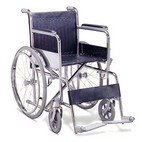
$6300 Manual wheelchair
... and no confidence in it's usability!
... and no confidence in it's usability!
Monday, 2 February 2009
Wheelchair Frustrations Part 2
Wheelchair Frustrations!
What do you get when you buy a $18,000 motorized wheelchair, or a $6300 manual chair??? Nada, nothing, zilch....
Of course they want you to buy the service contract, no doubt at inflated prices because it's a "health related" item.
Now if something breaks, I have to get on the phone and tell.....tell whom????...tell someone that "the do-hickey fell off of the thing-a-ma-jig so that the wigit now hangs off the big black thing."
It just seems to me that such expensive items, with parts that may need replacement, should have some information included with the product so that a capable owner is familiar with their chair, can look after it properly and safely and can intelligently inform a service department of problems they may be encountering.
Is a paper manual too much to ask?
(No Manuals Supplied For Wheelchairs!)
Your toaster continuously turns white bread into charcoal briquettes so you go down to your local department store and buy a new one. On returning home you open the box and out falls a 'User's Manual'. Shampoo Bottles come with the explicit instructions "Apply, Rinse, Repeat" for those unfamiliar with the concept of shampooing. The toaster is sure to come with a manual telling the purchaser the features, how to use the item, safety issues, trouble shooting, and exploded diagram of parts & components as well a list of the toll free numbers to service centers who are authorized to repair the unit should it need it. All this and probably in two or three languages as well.What do you get when you buy a $18,000 motorized wheelchair, or a $6300 manual chair??? Nada, nothing, zilch....
Of course they want you to buy the service contract, no doubt at inflated prices because it's a "health related" item.
Now if something breaks, I have to get on the phone and tell.....tell whom????...tell someone that "the do-hickey fell off of the thing-a-ma-jig so that the wigit now hangs off the big black thing."
It just seems to me that such expensive items, with parts that may need replacement, should have some information included with the product so that a capable owner is familiar with their chair, can look after it properly and safely and can intelligently inform a service department of problems they may be encountering.
Is a paper manual too much to ask?
Saturday, 10 January 2009
Wheelchair Distributor & Private Insurance Frustrations!
Wheelchair Distributor & Private Insurance Frustrations!
August 29th, 2008: Okay, so after one full year of waiting, I finally have the proper basic manual wheelchair in a configuration that I belive will work for me. Just in time for the September Labour Day long weekend starting on September 4th. Within days of having the wheelchair finally in a usable form allowing me to "trial" it further in the real world, the invoice arrives in the mail. $6300.00 due on receipt.
Well, I would really like to try it out now that I have the proper chair with proper seat and proper back etc. - that's what the "trial" should be! I can't very well evaluate it when I've been given the wrong chair or have the wrong back etc.
The invoice dated early August was postmarked August 29th and received in the first days of September. Within days I get the phone call from the chair distributor asking if they can send a driver over to pick up the payment. No!! Perhaps others have a spare $6300 laying around but I don't, particularly after having spent any savings on medical necessities not covered by government agencies or private insurance.
Look, let me submit the invoice to my private insurance carrier to see what they cover. When I receive the cheque, I'll send it along to you as well as any balance owing.
Previously by phone, I was informed by my private insurer that "the chair would be covered up to 100% for the customary ammount allowed in our area". Huh? They may fund 100% of whatever they decide upon? $3000 was given as the upper limit.
First Submission Of Claim:
Early October - So I send in the invoice and wait,...and wait... After some three weeks I get notification that they decline to fund. They need to know what portion ADP (Assistive Devices Program) has funded. Silly me, as no place on the submission form did they ask for that information when I submitted it in the first place. As I was submitting the total cost it should be self evident that ADP was not assisting in financing. Delay tactic number one.
I write a letter indicating that ADP is not funding any portion of the cost. The entire cost is mine.
Second Submission Of Claim:
Early November - Off it goes until another three weeks later I get another notification that they once again decline to reimburse me for any portion of the wheelchair. Why? Because I have to PAY IN FULL and send them proof of such before they will consider reimbursing me. Couldn't they have told me this on the phone during my initial call or in the notice of the first refusal?? I may be cynical but I believe they are playing games with me hoping I'll get frustrated and drop my claim. Delay tactic number two.
During this time I've been getting repeated terse phone calls from the supplier's Accounts Payable department demanding payment. Bordering on threatening. Very uncomfortable calls! I try to calmly explain that I'm waiting to hear back from my insurance company. I waited a year for the chair, can they not wait a few weeks for payment???
Early December - Well, It's coming up to Christmas by this time and with savings depleted and creditors breathing down my neck for payment, it looks like it will be a very bleak Chrismas season. I still don't have anywhere near the full amount they demand.
I get a phone call from the sales rep who was in charge of putting the chair together. I tell him of my frustrations and suggest if they can't wait for me to work the financial situation out that they should come and take the chair back.
TAKE THE CHAIR BACK???
He proceeds to tell me that I've had the chair far to long and that the company will refuse to take it back!!
Well, I've had the chair too long because it took you a year to get it put together in a useable form for me!!
What really bugged me was that while the sales rep was speaking to me over the phone, he kept muching away on an apple or some food item. The sounds of him stopping to chew, pause, think express his dismay, pause and chew again grates on me even more long after the call ended.
At least give me the respect of offering your full attention.
I have to wonder at what point the wheelchair went from being a "trial" item to being my, yet to be paid for, possession? On which date did I cross the line?
So, in the end, I begged, borrowed, but being in a wheelchair, couldn't steal - managing to scrape together $6300.00 from friends and family. The bill was paid in full, the invoice stamped "Paid in Full" was submitted to the insurance company for the third time and after about another three weeks received a cheque for $3000.00.
I do feel bad that I may have depleted some of the monies which were slated to be paid to the insurance company's CEOs as bonuses on top of their million dollar salaries. Wouldn't want to yank bread out of their children's mouths....
The Sales Rep I had dealt with over the months never called back with a thank you but then again I guess that would be too much to expect.
Long after having received my "Paid In Full" stamped invoice from the accounting department, they called once again asking this time in a civil tone if I had had any luck with my insurance company and when they could expect payment. I had paid in full weeks ago.
What competence!
I guess that all health care supply firms feel anyone in my position has a HUGE insurance settlement and can afford to pay outrageous prices while the private health insurance carriers believe everyone with that same insurance settlement doesn't need private health insurance reimbursement. Not everyone has a settlement of any sort.
What exactly is insurance, of any kind, for?? You pay monies into a fund which you hope to never have to use but if you do you know that major expenses will be covered and reimbursed should some major unforeseen calamity happen. It is to cover those major unforeseen expenses which otherwise you would never be able to afford. If your house burns down, your insurance will pay to rebuild it and restore it's contents. We have insurance because the home owner alone would not be able to come up with this amount of money on the spot after such a major disaster. Would the insurance company insist on the home owner rebuilding the home out of his own pocket and then submit a claim and wait for approval and reimbursement?? No, the insurance adjuster makes an assessment of the damages and issues payment so that rebuilding can commence. How then is it that after a catastrophic illness and all it's unplanned out of pocket expenses, does an insurance company require me to pay in full for the item in question and then they'll reimburse some part of it? No wonder why insurance companies are loved about as much as lawyers and politicians.
The whole reason I had extended health care insurance was that if I ever needed a wheelchair, or other major health care item, that it would covered, in whole or major part, so that I could afford this necessity and it wouldn't further stress my financial situation. Dream on!
I don't expect sympathy for my situation but a little bit of understanding and even some compassion would be welcomed. I found none...
Well, I would really like to try it out now that I have the proper chair with proper seat and proper back etc. - that's what the "trial" should be! I can't very well evaluate it when I've been given the wrong chair or have the wrong back etc.
The invoice dated early August was postmarked August 29th and received in the first days of September. Within days I get the phone call from the chair distributor asking if they can send a driver over to pick up the payment. No!! Perhaps others have a spare $6300 laying around but I don't, particularly after having spent any savings on medical necessities not covered by government agencies or private insurance.
Look, let me submit the invoice to my private insurance carrier to see what they cover. When I receive the cheque, I'll send it along to you as well as any balance owing.
Previously by phone, I was informed by my private insurer that "the chair would be covered up to 100% for the customary ammount allowed in our area". Huh? They may fund 100% of whatever they decide upon? $3000 was given as the upper limit.
First Submission Of Claim:
Early October - So I send in the invoice and wait,...and wait... After some three weeks I get notification that they decline to fund. They need to know what portion ADP (Assistive Devices Program) has funded. Silly me, as no place on the submission form did they ask for that information when I submitted it in the first place. As I was submitting the total cost it should be self evident that ADP was not assisting in financing. Delay tactic number one.
I write a letter indicating that ADP is not funding any portion of the cost. The entire cost is mine.
Second Submission Of Claim:
Early November - Off it goes until another three weeks later I get another notification that they once again decline to reimburse me for any portion of the wheelchair. Why? Because I have to PAY IN FULL and send them proof of such before they will consider reimbursing me. Couldn't they have told me this on the phone during my initial call or in the notice of the first refusal?? I may be cynical but I believe they are playing games with me hoping I'll get frustrated and drop my claim. Delay tactic number two.
During this time I've been getting repeated terse phone calls from the supplier's Accounts Payable department demanding payment. Bordering on threatening. Very uncomfortable calls! I try to calmly explain that I'm waiting to hear back from my insurance company. I waited a year for the chair, can they not wait a few weeks for payment???
Early December - Well, It's coming up to Christmas by this time and with savings depleted and creditors breathing down my neck for payment, it looks like it will be a very bleak Chrismas season. I still don't have anywhere near the full amount they demand.
I get a phone call from the sales rep who was in charge of putting the chair together. I tell him of my frustrations and suggest if they can't wait for me to work the financial situation out that they should come and take the chair back.
TAKE THE CHAIR BACK???
He proceeds to tell me that I've had the chair far to long and that the company will refuse to take it back!!
Well, I've had the chair too long because it took you a year to get it put together in a useable form for me!!
What really bugged me was that while the sales rep was speaking to me over the phone, he kept muching away on an apple or some food item. The sounds of him stopping to chew, pause, think express his dismay, pause and chew again grates on me even more long after the call ended.
At least give me the respect of offering your full attention.
I have to wonder at what point the wheelchair went from being a "trial" item to being my, yet to be paid for, possession? On which date did I cross the line?
So, in the end, I begged, borrowed, but being in a wheelchair, couldn't steal - managing to scrape together $6300.00 from friends and family. The bill was paid in full, the invoice stamped "Paid in Full" was submitted to the insurance company for the third time and after about another three weeks received a cheque for $3000.00.
I do feel bad that I may have depleted some of the monies which were slated to be paid to the insurance company's CEOs as bonuses on top of their million dollar salaries. Wouldn't want to yank bread out of their children's mouths....
The Sales Rep I had dealt with over the months never called back with a thank you but then again I guess that would be too much to expect.
Long after having received my "Paid In Full" stamped invoice from the accounting department, they called once again asking this time in a civil tone if I had had any luck with my insurance company and when they could expect payment. I had paid in full weeks ago.
What competence!
I guess that all health care supply firms feel anyone in my position has a HUGE insurance settlement and can afford to pay outrageous prices while the private health insurance carriers believe everyone with that same insurance settlement doesn't need private health insurance reimbursement. Not everyone has a settlement of any sort.
What exactly is insurance, of any kind, for?? You pay monies into a fund which you hope to never have to use but if you do you know that major expenses will be covered and reimbursed should some major unforeseen calamity happen. It is to cover those major unforeseen expenses which otherwise you would never be able to afford. If your house burns down, your insurance will pay to rebuild it and restore it's contents. We have insurance because the home owner alone would not be able to come up with this amount of money on the spot after such a major disaster. Would the insurance company insist on the home owner rebuilding the home out of his own pocket and then submit a claim and wait for approval and reimbursement?? No, the insurance adjuster makes an assessment of the damages and issues payment so that rebuilding can commence. How then is it that after a catastrophic illness and all it's unplanned out of pocket expenses, does an insurance company require me to pay in full for the item in question and then they'll reimburse some part of it? No wonder why insurance companies are loved about as much as lawyers and politicians.
The whole reason I had extended health care insurance was that if I ever needed a wheelchair, or other major health care item, that it would covered, in whole or major part, so that I could afford this necessity and it wouldn't further stress my financial situation. Dream on!
I don't expect sympathy for my situation but a little bit of understanding and even some compassion would be welcomed. I found none...
Subscribe to:
Posts (Atom)