





Showing posts with label Long Term Disability Income. Show all posts

Monday, 13 July 2009

Case-Cost Studies & Healthcare

Case-Cost Studies
(How To Take The Care Out Of Healthcare)

As mentioned in a previous post, in a a rather misguided move to save my hospital money, the management closed the 'self-pay' outpatient physiotherapy service (which brought outside money into the hospital) and moved me over to the OHIP(1) or government funded physiotherapy service which is funded by the Ontario taxpayer. In other words, in an attempt to save the Ontario taxpayer money, they switched me from private insurance covered therapy to Ontario taxpayer funded therapy. Go figure!!

I'm sure the Ontario government (or Health Canada) did numerous studies requiring numerous consultants putting in numerous hours of overtime crunching numbers in order to develop cost-case data. These cost-case studies refer to the nature of patient treatment, number of hours of therapy, length of hospital stay and maximum number of hours to be invested etc. in any particular ailment, injury or disease encountered by the appropriate health care facility and it's personnel.

If, say you had a stroke, you would be entitled to x-hours of therapy, only a, b and possibly c drugs, and, oh, 4.76 days of inpatient hospital stay followed by no more than 'y' weeks of outpatient physiotherapy. No more..... but possibly less!

The algorithm has been established by highly paid bean counters, number crunchers and paper pushers in order to establish "appropriate therapy" for the "average patient".

But is there an "average patient"? We are all different with different levels of initial health, different prognoses and responses to therapeutic drugs as well and other therapy. Should each patient not be followed carefully, observing their response to treatment an have it adjusted accordingly, even if some therapy may be unconventional? Should therapy on a non-responsive patient be terminated sooner or should therapy be modified or perhaps extended. Should it not be the goal of any health care facility and the government funded care to restore a person to as close to a healthy and productive state as possible, rather than cut them loose after, say, a hypothetical 12.23 weeks of treatment? Should a patient making significant progress be cut loose after those same 12.23 weeks even though additional treatment will benefit the patient further?

We citizens are not all the same, cut by the same cookie cutter mould, nor should the health care offered be cut by that same mold.

As in my case, it would seem that having me return to a state of health & mobility where I can return to work, earn a living and pay the government my taxes far preferential to having me sit at home on welfare or disability payment. My government should be encouraging health care facilities to do whatever it takes to restore me to a productive state. That would save money in the long run rather than trying to save on the administration of healthcare.

That said, OHIP allows me to receive 16 weeks (max) of physiotherapy after which time I am cut loose regardless of my needs or progress. No ifs, ands, or buts....
My 16 weeks will run out in this upcoming August after which I'll be on my own.

After my initial injury I was told at discharge from the hospital that I'd never walk again. I began receiving physiotherapy 2 to 4 times weekly which has continued for over two years now. I've progressed from having to be hoisted around on a sling to where I can walk unassisted with a walker. I am continuing to improve although the pace is slow.

Imagine if I only had our Canadian Socialized medicine to rely on as administered by OHIP? I would have been discharged as a useless immobile lump after 16 weeks. Goodbye - have a nice life! Luckily, through my workplace, I had supplemental private insurance and luckily they had stubbornly negotiated unlimited physiotherapy. It is only because of that that I have a chance of being independently ambulatory in the future.

How many of us citizens rely totally on OHIP for our healthcare? How many are rich enough to purchase whatever additional therapy we might need with our own savings? How many have supplemental private insurance through our workplace or are astute enough to purchase private insurance coverage when healthy in anticipation of something which we feel will never happen to us? Such a delicate safety net separates us from the hard reality of chronic illness or disabling injury.

Come some date in August I shall be on my own regarding my continuing recovery and progress or I can return to my private insurance for therapy at some private (for profit) clinic in my community.

We in Canada would like to believe that we are compassionate, extending healthcare to those in need, however it is measured and meted out in pre-determined doses at the discression of the government.

(1) OHIP - Ontario Health Insurance Program (Socialized Medicine)

Sunday, 17 May 2009

Attempt To Return To Work

Attempt To Return To Work
(Including Regaining My Professional Practising Status)

Late August 2008:

So what could go wrong? I'm bored to death and LTD (Long Term Disability) income sucks so perhaps now is the time to return to work.

My Doctor's eyebrows raised when I informed him I'd like to return to work. Really?
I need a 'Return To Work' form signed by him in order to proceed.

Approached Human Resources at my workplace but they tell me Occupational Health handles any return to work issues. I motor down to Occupational Health and speak to them about returning to work. No! - return to work requests have to go through my Private Insurance Carrier, not my employer. So I contact my Private Insurer about returning to work. Unlike my claims reimbursement submissions which take weeks to be acted upon, I had a date set for an interview shortly thereafter.

The Interview: Did not expect this. A two hour interview on issues such as "what pets I have" and "how many rooms I have in my home". Now, if I had a pet monkey and lived in a one room dwelling, I can't see how that would be important in my returning to a job that I still have. I didn't have such an extensive interview on applying for the job in the first place, some two decades ago.

More forms and papers passed back and forth for signing.

As I am employed as a medical technologist in a hospital lab, my skill is 'licensed' by a regulating college. When I first came home after my injury I called the college and placed myself on 'non-practising' status as it was not only truthful but cheaper in these monetarily challenged times. My college informed me that I can switch to non-practising for a period of two years and then return to practising without any consequences. What they failed to tell me at that time was that if I didn't reach the magic number of 900 hours worked in the previous year, the year would count as zero hours, or not worked at all. I was just under so that year didn't count.

So when I tried to regain my practising status I was now informed that after 30 years in the business, 20 of which at the same job with the same employer, I was a few hours short and had to take a refresher course. Because I am still dependent on a wheelchair, I couldn't commute and needed something offered by correspondence. Two courses met my requirements and that of the college but one course was 5 hours short of the 60 hours the college stated I needed and they wouldn't bend on the issue.

After 30 years of employment 5 hours separated me from regaining my practising status!

Well I chose the other option and after some difficulties in getting registered I was enrolled in the refresher course rated at 80 hours, over 36 weeks which arrived in three 3 inch binders.
I took this issue seriously and crammed my 36 weeks into 4 strait weeks of studying. As I was familiar with most this material, it wasn't too difficult.

After 30 years in the discipline, asking me to take a basic refresher was akin to having an executive secretary returning to the workforce take a course on which is the business end of a pencil and what is a computer keyboard.

The refresher course was tested with 10 one hour exams which I wrote in three sessions and in about 5 hours. Now I'm waiting for the marks to arrive so I can forward them to the college for reinstatement.

Ergonomic Assessment:
I did have an ergonomic assessment at work to see how I could physically fit in to the lab. I felt I had very few problems. I wanted as few changes as possible as this was the real world and I could adapt or figure out how to do some task or reach particular items. Unbelievably, the assessor had me reach for various items while she took measurement of my arm to the item, of the item to the floor etc. Then the same was documented in photographs, Thorough!

Now, the only difference pre and post injury is that I am unable to step away from the wheelchair without a walker, why on earth do they want to get me an ergonomic computer keyboard? My hands and my reach are unaffected! Go Figure!

So, I've jumped through all the hoops and all I have to do now is to wait for my marks, forward them to my college and inform the Occupational Health Department of my status.

If the past holds true, I'm certain more obstacles will find there way into my path.

So, I started inquiries about returning to work in August of 2008 and now it's May of 2009.

My attempt to return to a job that I still have has taken about 9 months so far.

Wednesday, 1 April 2009

Long Term Disability Income

Long Term Disability Income

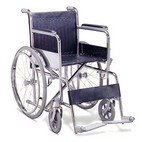
The moment I expressed an interest in returning to work, my private insurance carrier broke into cheers and deemed that I was no longer disabled therefore my Long Term Disability Income (LTD) was to be terminated. As Of April 3rd, I will no longer have any LTD money as income and as it is my only source of income, I'll be coasting on whatever I have left after paying off the $6300.00 wheelchair.
(I guess I can roll down to the street corner and sell pencils from a tin cup in the interim.)

The next post is all about my efforts in returning to my workplace.