





.jpg)
.jpg)
.jpg)

Well, its been a while since my last post for although things still change, it is far to slow for my liking. This has been a challenging summer on several fronts.
No Continuing Physiotherapy:
Those who have followed this blog know that I no longer receive physiotherapy. Not my choice however with all levels of government crying poverty, funding cuts are passed on to the community. Community hospitals which once provided the level of expertise in physiotherapy that an injury as severe as mine requires now had to deal with a frozen operational budget. The provincial government however had the funds to create LHINs (Local Hospital Integration Networks) which were are an "arms length" agency that in a sense does the government's dirty work for them. They suggest what services should be eliminated from hospitals under the premise that they are already available in the community by private providers. This in theory would duplication of services available in the community and funds saved could be channeled into core hospital programs. Of course governments often fail to see the big picture. Hospitals provided that level of expertise (spinal cord, stroke, brain injury) that private community physiotherapy clinics who deal with primarily with sports injury or minor trauma rarely see. Expertise developed not only through continuous encounters with people suffering from such catastrophic injuries but also in the acquisition and use of specialized equipment to aid in rehabilitation which smaller private clinics simply can't justify buying.
With the closure of hospital physiotherapy (and other) clinics, patients either terminated their therapy or attempted to find nearby private clinics which would continue their therapy on some level. It was quickly apparent that the sudden influx of new clients quickly overwhelmed the private clinics.
The irony was that outpatient physiotherapy clinics actually brought outside monies (insurance or self-pay) into the hospital, above and beyond the government funding. Go figure!
*the private clinic I attended over the winter of 2009-2010 was chosen primarily because of location.(it was nearby). Perhaps more specialized clinics could be found on the other side of the city or in the next town however travel time was a significant factor, dependant on public disability transportation service scheduling.
The private clinic I attended had no handicapped automatic door opener, had no parallel bars and had to rent a walker for my use. Hardly equipped for my needs.
Disability Transport Goes On Strike:
As mentioned above, provincial governments have cried poverty and indicated that budgets would be frozen for the foreseeable future. Yet, at a time when most are grateful just to hang onto their jobs, the union for the public disability transportation service which takes me to and from work each day coerced members into strike action. So in mid summer they took to the picket line leaving the non-unionized transit management scrambling to meet their obligation. Rides were quickly outsource to a private cab company that usually just handles the overflow from the provincially funded disability transportation service. While I was prepared to leave my powerchair at work and have my wife shuttle me back and forth by car with my manual chair, the cab service worked extremely well, so much so that my times were usually better resulting in a shorter commute. While priority for rides was assigned by necessity - medical appointments, work, and leisure, I never was without timely transportation. After about six weeks the strike ended with not much being accomplished. Drivers sacrificed a pay-cheque for this time away however did retain their benefits in the new contract which was a big issue. The transportation agency probably saved some money on salaries, fuel and vehicle maintenance but as they had to pay the cab company for service, the savings were probably not substantial. It was a lose-lose-lose situation between drivers, management and clients...
New Powerchair:
It has been over six years since my injury and my acquisition of an electric wheelchair. The chair was presented to me while an inpatient at Toronto's Lyndhurst Rehabilitation Hospital. I had no input as to the vendor, model or specification as with no previous experience, I relied on the hospital's expertise. All in all, they did a fine job in matching the chair to the person (me) - or perhaps, because I had no previous experience with a powerchair, whatever I was given seemed right. I had nothing to compare it to.
Well, after six years of use and abuse, my first and current chair "on it's last legs" (no pun intended). The detachable leg supports have been bent, straightened, re-bent, replaced and re-bent. They splay out and twist in, stick out and catch on any obstacle, however small, that extends above flat ground. The arm rests were some of the first luxury items to go, Shredded off like cheese on a grater while rubbing along the sides of the bus lift. The tilt motor stopped working years ago - once considered a necessity to shift my weight in order to prevent pressure sores. Skin issues never materialized and so when the motor stopped operating, I decided against submitting a claim to my insurance company for unreasonable cost of replacing the unit. The front and back castors rubber treads are all but warn off. The original battery still takes a charge but loses it much more quickly. The chair creaks and groans but continues to run in spite of the abuse I inflict on it daily. However, I cannot continue to push my luck It was time to look into getting a new powerchair.
Am I entitled?
When I received my first powerchair while completely paralyzed from the chest down. Things have improved greatly since my discharge from the hospital to where now I can even wiggle a few toes to some degree. As I work at a hospital, I see wheelchair bound people daily, some elderly, some with visible physical deficiencies, yet using manual wheelchairs. I had to wonder if it was their own choice to propel themselves using their own power, or did they settle for the less expensive manual chair because of their limited finances? Even with the provincial government's ADP's assistance (Assisted Devices Program), the 25% cost the client must pay can be prohibitive.
Even with my decent income, the full cost of a new powerchair would make it out of reach for me.(my first powerchair with tilt cost $18,000) - A "Catch 22" situation - I would be working only to pay for the chair and I would need the chair only so that I could work.
So the question was;
As I have excellent upper body strength and am able to propel a manual chair with ease, would I still qualify for ADP assistance for a powerchair, in light of many other people with less ability using manual chairs as their sole source of mobility? I would find it a significant financial burden to buy one without their assistance yet I need a powerchair to do my job. I need one hand free to carry items and I need the braking mechanism in the powerchair so that I can brace against it to stand up (a manual chair's brakes are not sufficient to keep it from rolling back.
The choices are - would the government prefer to assist my purchase of a powerchair which would keep me a productive taxpaying citizen, or to deny assistance, leaving me unable to do my job which would result on my falling back on disability and having the taxpayers support me.
The Result:
With the help of an acquaintance, I contacted a sympathetic ADP authorized occupational therapist. She assisted in getting authorization for the ADP assisted purchase of a new chair. As a seating specialist she also recommended and provided seating much superior to what I currently was using. She contacted the sales representative for a powerchair supplier and started the process. I'll have more about my chair selection process in an upcoming post.
Saturday, 8 September 2012

Sunday, 1 January 2012
The Same In Spite Of Change
It has been a while since I posted as although my situation continues to change, my ultimate goal of walking unassisted has not been attained. Here are a few observations and thoughts...
Pain; When the inflammation receded in early January of 2007, movement in my legs began to return but along with it, the pain generated by damaged nerves. I found that no drug relieves this neurogenic pain as most analgesics (pain killers) block the transmission of pain generated in the pain sensors to the nerves and ultimately the spinal cord (an oversimplified explanation). The spinal cord itself generates this pain and all drugs available have little or no effect on my level of pain (Gabapentin, Lyrica, Nortryptiline, Amytriptyline). Nortryptiline may exhibit very minor relief. As such, I've taken myself off Gabapentin and found no increase in my level of pain. Why take medication if it does nothing?
I have to wonder how my pain compares to others with similar spinal cord injuries. As my injury was from infection I have to wonder how damage cause by bacterial enzymes & toxins compares to that caused by traumatic (crushing or severing) injury. That is, how does my pain generated by intact but damaged nerves compare to someone whose nerves are actually severed. Do neuro-pathways that are damaged still conduct more pain than nerves that are cut and not connected. Is my pain more, less or the same regardless of method of injury? Can such magnitude of pain even be measured?
Regardless, while movement continues to improve to some degree, the pain which began to be felt almost 5 years ago to the day has neither increased or decreased.
Movement; Having been told on leaving the hospital 5 years ago that I would never walk again, I arrived home paralyzed from the chest downwards. Since that time, movement has slowly but steadily returned to the point where I can wiggle some toes on both feet to some degree. Plantarflection (standing on my tip-toes) is not an effort at all. Dorsiflection, (lifting my foot off the ground with my heels on the floor) was slow to return. I was lead to believe that this was a neurological problem but with increased walking and stretching, I feel it has more to do with the tendons and ligaments having shortened with disuse. Like trying to rejuvenate dried up & cracked weathered leather, it is very hard to stretch out and restore the supple nature of tendons. I can stretch out for an hour but in the next hour they tighten again. It is sort of a 'catch 22" situation where I would have to be walking constantly have them stretch out properly but as they aren't stretched out, I can't walk constantly. Perhaps the dreaded 'Tone' plays a role here as well.
So after 5 years post prognosis, I can stand in place upright unassisted but there is an unsteadiness that is difficult to overcome. As if all muscles don't work in concert and hold the body perfectly taut. Being upright and walking more would help this but again, the 'catch 22".
I can walk some distances with the aid of a walker and walk between the parallel bars with almost a normal gait as long as I hold on. Close, but not there yet. The next challenge is to be able to stand one one foot. Right now I can't correct those small wavering movements to hold my self taut and upright. On one foot I start leaning in one direction or another and can't correct fast enough to regain my upright position. If I can continue to improve the dorsiflection, I'm hoping that I can take steps without any major orthotic apparatus. Trying to walk too fast, I find my toe will catch the floor/carpet and I may trip myself.
So, I can stand unassisted and walk some distances assisted and things are still changing.
People talk about "muscle memory" where your body (muscles) remember what they are suppose to do after a period of disuse. I've not found that. I've found that muscles have to come back in their own sequence and at their own schedule. I have repeatedly stood and toppled over onto my chair or bed until one time I tighten or engage some muscle and find myself saying "oh, that's how its done". No "muscle memory" - I have to relearn and tell them what to do. It is interesting to notice the sequence of how the muscles come back and what they do. Things that able bodied people do not notice or take for-granted. It reminds me of the American Stealth B-1 Bomber which flies by computer where the software makes thousands of corrections to the flight surfaces every second, allowing it to fly. Standing upright, thousands of tiny muscle fibers fire as necessary in an ever changing sequence to keep on upright. This complex orchestration goes unnoticed by the healthy individual.
Tone; That muscular tightness not due to lack of exercise but rather some signal from the injured spinal cord (or brain) still plagues me. It has diminished somewhat over the years but is present. How much that remains is 'Tone' and home much is still due to muscles not fully returned to pre-injury state is yet to be determined. Walking upright involved the back muscles to a great degree and I find they fatigue the quickest when upright. However, the more I force myself to stand upright I find improvement follows. I stand upright at work and file papers which forces me to twist and turn on the spot. I do this until the muscles begin to burn and the body begins to shake with fatigue. Slowly, it becomes a bit easier with each passing week. I find it amazing that 6 months of complete inactivity in a hospital bed can cause the muscles and tendons to shorten so much that it takes 6 years to return them somewhat to their pre-injury state.
Spasms; These still show up but fluctuate. Most often at night when I try to relax after a workday, The left hip or the right leg will start off slowly, twitching, then jumping - sometimes for minutes and sometimes for hours. Very, very annoying,
Sciatic Nerve Pain; Still bothers me but with perhaps more good days than in previous years. I am convinced that this was not really the result of my neurological injury but rather that I lay in a hospital bed for so long in one position where lying towards one side was favored. I believe it is more a function of the muscles that are located in the lower back and pelvis that control the action at the hip, have become disproportionally shortened and therefore pull the hip out of alignment with resulting pain. Continued exercise may eventually reduce this to tolerable levels.
The bottom line is that I experience constant severe pain on my bad days and extreme discomfort on my good days. This is during all my waking hours (I don't feel pain while asleep) for the last five years and most likely for the rest of my life. Having your mind drawn away from your daily tasks every few minutes is really is no way to live.
Work; I have been back at my workplace now for over two years without any major problems. They have been accommodating however I need very little special consideration. I can stand without any problem (I just can't step away from my chair). I can reach down unassisted and pick a sheet of paper off the floor without major effort. I can operate instruments with foot switches with no problem. There is very little that I can't do however it remains a very big nuisance to be attached to and dependant upon this wheelchair.
Future; I'm not certain if further physiotherapy would be of any help. I've wondered if a chiropractor could help with my sciatic pain. I've checked into local pools with disability access however have yet to take advantage of any. I'm sure that this could help with movement as well as burning off calories and weight gained from just sitting.
Wheelchair; My electric wheechair had gone through many repairs over the last 5 years and it, like me, may be on it's last legs. I fear that I have regained too much mobility to qualify for monetary assistance in acquiring a new chair. The one I currently have cost $18,000 of which 3/4 was subsidized by the government. If I don't qualify, the entire cost would be mine alone to bear. I'm not sure if I could afford that amount, yet I need a motorized wheelchair to do my job. (one hand on the joystick to drive, and one to carry items). I could not do my job with a manual chair. Nor would one of those 'Hover-round' motorized scooters work as the ones I've seen have a steering column out front and can't be parked under a desk.
So, do I spend big $$ to continue working or will I be forced to quit, retire early, go on disability when the service company can no longer repair this old buggy?
You'd think that the government would be happier to see me as a productive citizen paying taxes rather than sitting at home draining disability from others that may truly need that assistance. But then again we're talking government and logic often eludes them. We shall see...
Summary; What I've come to realize that with my injury, the paralysis is the most insignificant problem that I can work on and overcome. It is all the rest that tags along with this injury that destroys one - the constant extreme pain, the tightness and the spasms.
Pain; When the inflammation receded in early January of 2007, movement in my legs began to return but along with it, the pain generated by damaged nerves. I found that no drug relieves this neurogenic pain as most analgesics (pain killers) block the transmission of pain generated in the pain sensors to the nerves and ultimately the spinal cord (an oversimplified explanation). The spinal cord itself generates this pain and all drugs available have little or no effect on my level of pain (Gabapentin, Lyrica, Nortryptiline, Amytriptyline). Nortryptiline may exhibit very minor relief. As such, I've taken myself off Gabapentin and found no increase in my level of pain. Why take medication if it does nothing?
I have to wonder how my pain compares to others with similar spinal cord injuries. As my injury was from infection I have to wonder how damage cause by bacterial enzymes & toxins compares to that caused by traumatic (crushing or severing) injury. That is, how does my pain generated by intact but damaged nerves compare to someone whose nerves are actually severed. Do neuro-pathways that are damaged still conduct more pain than nerves that are cut and not connected. Is my pain more, less or the same regardless of method of injury? Can such magnitude of pain even be measured?
Regardless, while movement continues to improve to some degree, the pain which began to be felt almost 5 years ago to the day has neither increased or decreased.
Movement; Having been told on leaving the hospital 5 years ago that I would never walk again, I arrived home paralyzed from the chest downwards. Since that time, movement has slowly but steadily returned to the point where I can wiggle some toes on both feet to some degree. Plantarflection (standing on my tip-toes) is not an effort at all. Dorsiflection, (lifting my foot off the ground with my heels on the floor) was slow to return. I was lead to believe that this was a neurological problem but with increased walking and stretching, I feel it has more to do with the tendons and ligaments having shortened with disuse. Like trying to rejuvenate dried up & cracked weathered leather, it is very hard to stretch out and restore the supple nature of tendons. I can stretch out for an hour but in the next hour they tighten again. It is sort of a 'catch 22" situation where I would have to be walking constantly have them stretch out properly but as they aren't stretched out, I can't walk constantly. Perhaps the dreaded 'Tone' plays a role here as well.
So after 5 years post prognosis, I can stand in place upright unassisted but there is an unsteadiness that is difficult to overcome. As if all muscles don't work in concert and hold the body perfectly taut. Being upright and walking more would help this but again, the 'catch 22".
I can walk some distances with the aid of a walker and walk between the parallel bars with almost a normal gait as long as I hold on. Close, but not there yet. The next challenge is to be able to stand one one foot. Right now I can't correct those small wavering movements to hold my self taut and upright. On one foot I start leaning in one direction or another and can't correct fast enough to regain my upright position. If I can continue to improve the dorsiflection, I'm hoping that I can take steps without any major orthotic apparatus. Trying to walk too fast, I find my toe will catch the floor/carpet and I may trip myself.
So, I can stand unassisted and walk some distances assisted and things are still changing.
People talk about "muscle memory" where your body (muscles) remember what they are suppose to do after a period of disuse. I've not found that. I've found that muscles have to come back in their own sequence and at their own schedule. I have repeatedly stood and toppled over onto my chair or bed until one time I tighten or engage some muscle and find myself saying "oh, that's how its done". No "muscle memory" - I have to relearn and tell them what to do. It is interesting to notice the sequence of how the muscles come back and what they do. Things that able bodied people do not notice or take for-granted. It reminds me of the American Stealth B-1 Bomber which flies by computer where the software makes thousands of corrections to the flight surfaces every second, allowing it to fly. Standing upright, thousands of tiny muscle fibers fire as necessary in an ever changing sequence to keep on upright. This complex orchestration goes unnoticed by the healthy individual.
Tone; That muscular tightness not due to lack of exercise but rather some signal from the injured spinal cord (or brain) still plagues me. It has diminished somewhat over the years but is present. How much that remains is 'Tone' and home much is still due to muscles not fully returned to pre-injury state is yet to be determined. Walking upright involved the back muscles to a great degree and I find they fatigue the quickest when upright. However, the more I force myself to stand upright I find improvement follows. I stand upright at work and file papers which forces me to twist and turn on the spot. I do this until the muscles begin to burn and the body begins to shake with fatigue. Slowly, it becomes a bit easier with each passing week. I find it amazing that 6 months of complete inactivity in a hospital bed can cause the muscles and tendons to shorten so much that it takes 6 years to return them somewhat to their pre-injury state.
Spasms; These still show up but fluctuate. Most often at night when I try to relax after a workday, The left hip or the right leg will start off slowly, twitching, then jumping - sometimes for minutes and sometimes for hours. Very, very annoying,
Sciatic Nerve Pain; Still bothers me but with perhaps more good days than in previous years. I am convinced that this was not really the result of my neurological injury but rather that I lay in a hospital bed for so long in one position where lying towards one side was favored. I believe it is more a function of the muscles that are located in the lower back and pelvis that control the action at the hip, have become disproportionally shortened and therefore pull the hip out of alignment with resulting pain. Continued exercise may eventually reduce this to tolerable levels.
The bottom line is that I experience constant severe pain on my bad days and extreme discomfort on my good days. This is during all my waking hours (I don't feel pain while asleep) for the last five years and most likely for the rest of my life. Having your mind drawn away from your daily tasks every few minutes is really is no way to live.
Work; I have been back at my workplace now for over two years without any major problems. They have been accommodating however I need very little special consideration. I can stand without any problem (I just can't step away from my chair). I can reach down unassisted and pick a sheet of paper off the floor without major effort. I can operate instruments with foot switches with no problem. There is very little that I can't do however it remains a very big nuisance to be attached to and dependant upon this wheelchair.
Future; I'm not certain if further physiotherapy would be of any help. I've wondered if a chiropractor could help with my sciatic pain. I've checked into local pools with disability access however have yet to take advantage of any. I'm sure that this could help with movement as well as burning off calories and weight gained from just sitting.
Wheelchair; My electric wheechair had gone through many repairs over the last 5 years and it, like me, may be on it's last legs. I fear that I have regained too much mobility to qualify for monetary assistance in acquiring a new chair. The one I currently have cost $18,000 of which 3/4 was subsidized by the government. If I don't qualify, the entire cost would be mine alone to bear. I'm not sure if I could afford that amount, yet I need a motorized wheelchair to do my job. (one hand on the joystick to drive, and one to carry items). I could not do my job with a manual chair. Nor would one of those 'Hover-round' motorized scooters work as the ones I've seen have a steering column out front and can't be parked under a desk.
So, do I spend big $$ to continue working or will I be forced to quit, retire early, go on disability when the service company can no longer repair this old buggy?
You'd think that the government would be happier to see me as a productive citizen paying taxes rather than sitting at home draining disability from others that may truly need that assistance. But then again we're talking government and logic often eludes them. We shall see...
Summary; What I've come to realize that with my injury, the paralysis is the most insignificant problem that I can work on and overcome. It is all the rest that tags along with this injury that destroys one - the constant extreme pain, the tightness and the spasms.
Techno-Zombies
Techno-Zombies - A name I gave to those annoying, self absorbed idiots who cannot wait for a few moments and find an appropriate (safe) location to check their voicemail, their e-mail, their Tweets or update their Facebook status. Head down, thumbs-a-flashin', plodding along, weaving down the sidewalk or hallway, oblivious to people and obstacles - bouncing off both with nary an apology. Self absorbed in their own world and by their own importance. Education & intelligence have no bearing on who becomes mesmerized by the hand-held device. Teens having to reply to their BFF immediately lest they miss out on some party. Physicians checking their patient's status on the run with diverted attention makes for bad medicine - or perhaps Doc is just checking how his stocks are doing or booking a golf game.
Then there are the human obstacles who like hair & grease in a plugged drain block the free movement of people who actually have a purpose and destination. Wheeling down some hallway I frequently have to stop and wait while others, oblivious to my presence, refuse to share the space. Then there are the others, again so self absorbed, that they watch me wheel up, give me a momentary glance, and resume their conversation. Does my presence not register in that pea-brain of theirs or do they just not care? When my path is otherwise blocked, do I really have to roll up to one inch of your knees and shout excuse me to be noticed? My presence is an annoyance. I've heard it said that if you are in a wheelchair, you fly under society's radar and go unnoticed. You become a non-person.
Some of the human flotsam & jetsam that impedes the orderly flow of traffic are include, but are not restricted to those below;
Then there are the human obstacles who like hair & grease in a plugged drain block the free movement of people who actually have a purpose and destination. Wheeling down some hallway I frequently have to stop and wait while others, oblivious to my presence, refuse to share the space. Then there are the others, again so self absorbed, that they watch me wheel up, give me a momentary glance, and resume their conversation. Does my presence not register in that pea-brain of theirs or do they just not care? When my path is otherwise blocked, do I really have to roll up to one inch of your knees and shout excuse me to be noticed? My presence is an annoyance. I've heard it said that if you are in a wheelchair, you fly under society's radar and go unnoticed. You become a non-person.
Some of the human flotsam & jetsam that impedes the orderly flow of traffic are include, but are not restricted to those below;
* * *
- The Weaver (aka Zig-Zagger) - doesn't pick a side of the hallway but drifts from left to right and back again repeatedly.
- The Obstacle - stops dead in the middle of the hallway to check their hand-held for messages. Like a rock in a river, other traffic must flow around both sides.
- The Orangutan - walks down the hallway with arms swinging out from their sides threatening to slap anyone who attempts to pass. A variation of this adds shoulder bags, purses, shopping bags, etc to the arsenal attempting to bombard the passerby.
- The Coffee Clutch - like a log jam in a river, may start small with one or two people engaged in a hallway meeting, but often grows as more people get snagged and join into what eventually becomes a full fledged hallway seminar.
- The Ping-Pong Ball - walking full speed down the hallway, suddenly realizes they've forgotten something from where they came and instantly change direction back, usually running into whomever is immediately behind them. The true ping-ponger may remember, then decide it isn't important, then reconsider, then change their mind again, seemingly bouncing back and forth in a three foot span of space in the middle of the hall.
- The Darter - Darts out of side doorways without looking to see if the hallway is clear. Storm out of a doorway looking only in the direction of their travel while others have to stop short to avoid rear-ending each other.
- The Racer - Doing the lap around a corner these folks cut the corner sharply (right side of hallway to left side of new hall) to avoid a few extra steps and save a few microseconds. The racer often bumps head-on the the person rounding the corner in the opposite direction.
- The Salmon - like the fish that swims upstream to reproduce, these folks resist the flow of current in one direction and try to maneuver upstream through that flow dividing oncoming traffic.
- Deer In The Headlights - confront them head on and they just stand there with a blank "deer in the headlights" look in their eyes. Hello! I said excuse me - I can't dematerialize and roll through you. Why do you think I've stopped here inches from your knees?
- The Brit - (no disrespect to my British friends) - The unwritten convention is to walk on the same side of the hallway as the side of the road you drive on. Here in North America that being the right side. This prevents people from meeting head-on and having to do the Tango or 'play chicken' as they decide if or who will move and to which side.
- The Line Dancers - Side by side, two, three, more...hold hands or have arms entwined as they sweep down the hallway refusing to break for anyone.
- The Lousy Shepherd - Unconcerned parent with kids that stray in every which direction with no discipline or control. Like trying to herd cats! Control your offspring or leave them at home.
- Darwin's Legacy - the most dangerous, often to themselves. Walking, texting, i-pod blasting through earphones, disengaged, lost in thought and oblivious to all dangers around them. These are the clowns that run into you and crumple into your lap, that in their oblivion walk into traffic, & fall down staircases.
There are numerous other variations as you can imagine...

There is also the opposite, the over considerate person who immediately decides that because you are in a wheelchair that they must do everything in their power to help you, even if you politely decline their assistance. Thank you, its my feet that don't work well, you don't have to exit and then re-enter the elevator to push my floor button for me. It's my feet, not my ears - you don't have to speak louder because I'm in a wheelchair. I try not to discourage these people, politely declining assistance I don't require but accepting what they insist on offering. Perhaps the next wheelchair bound person will need such help.
Offer assistance if you see me struggling, otherwise assume I'm doing fine - and Thanks anyways.
People, please be aware of your surroundings for the benefit of others and for your own safety. Civilization means we are civilized and should act in a civil manner towards each other. Offer common courtesy to all you encounter and you will probably receive respect in return. Most of all, just Think!

Thank you for your attention!
Saturday, 12 February 2011
Flat Tire
Well, the good news is that its only flat on the bottom!
 It may have happened a week ago...or maybe just the previous day. Perhaps there was just one sheet of paper too many. The custodian may have been in a rush to finish sweeping the floor that evening. Regardless, events converged this Saturday morning to send some grief my way.
First to arrive at work, I began to settle into my routine. Within minutes of driving my chair about the room, I realized something was amiss when the wheelchair began to klunk and sag to one side. My first flat tire since I acquired this 300 pound set of wheels strapped to my ass.
Somewhere between panic and disgust, I assessed the situation. Co-workers had yet to arrive and wouldn't be able to offer any meaningful assistance. I didn't carry any of the wheelchair service phone numbers with me so I phoned my wife and asked her to contact the wheelchair technician on my behalf. With my home only minutes from my workplace, I also asked my wife to bring my manual wheelchair to my workplace so that I could at least maneuver without damaging the rim. Still, this wasn't the solution for to drive the manual wheelchair, I needed both hands free to power myself about the room. With the electric chair I could carry supplies in my left hand while driving by use of the joy-stick with my right.
 Well, to make this long story short, the technician on-call this weekend was on the other side of Toronto and thought he would need about 1.5 to 2 hours to gather his gear and make it across town to my workplace. Bang on! On arrival he quickly replaced the flat tire and discovered that it was a common household paper staple which had punctured the heavy nylon tire. One tang had made it through whatever sheaf of paper it had tried to secure, however the thickness proved to be just too much for the other tang to poke through. Instead the point had curled up around itself and created with minute wire ball with a point. Someone had pulled it back out then carelessly tossed it in the general direction of the waste basket, That's all it took to drop my tire pressure and raise my blood pressure.
It cost about $200 Cnd to pay for the technician's weekend 'call-back', the labour and new tire however I finally did find myself back in business. I had feared that the expense would be mine alone however I was pleasantly surprised when my private health insurance picked up the tab for all costs.
That evening I went out to purchase a pressurized can of aerosol tire repair. A can of sealant and compressed gas used to seal and inflate the tire in one step. No idea of how effective it may be and have no desire to find out.
* * *
Saturday, 9 October 2010
And Another Year Passes...
Another year post injury….and it was early January in 2007 that I first noticed that movement was returning to my legs and torso as the inflammation around my injured spinal cord receded. Regaining my mobility was welcomed however the same reduction of inflammation which finally was beginning to allow movement signals to get through was also allowing pain signals to get  through. In other words it was a ‘two-way street’. The spinal cord carried both signals of motion but also the signals of pain and as one increased so did the other. The pain was ‘neurogenic’ and felt like burning pins and needles from the knees down. So severe that it is hard to take one’s mind off of the intense discomfort for more that a few minutes. Trying to do a task, my attention is constantly and repeatedly drawn to my painful legs and with that distraction comes the possibility and probability that errors will result in whatever I’m engaged in. As mentioned in earlier posts, this neurogenic pain is unlike conventional pain and the common analgesics (ibuprofen, acetaminophen, aspirin, percocet, etc) will not ease it. Of the four drugs that are thought to have an effect on nerve pain (Gabapentin, Lyrica, Nortryptiline and Amitryptaline) neither has any appreciable effect on me. So, with a smile and a hand on my shoulder, the doctor ushers me out his office door and tells me to learn to live with the pain.
So I try to come to terms with having to live out the rest of my life as if my legs are immersed in boiling water - severe chronic pain till the end of my days…Not a happy prospect.
I sometimes wonder how my pain compares to others with spinal cord injuries. My injury is due to bacterial growth and toxins which killed off or altered the spinal cord cells. The cord is ‘intact’ as such but damaged. Is my pain worse because damaged yet viable cells are all sending pain messages to my brain? How does that compare to someone who has had physical trauma where the spinal cord is severed to some degree. Does this person suffer less pain because there no longer is a physical connection and the pain signal is not generated or cannot get through? An analogy would be that if you cut the electrical cord going to your table lamp the light goes off. But, as if in my case the cord is still there but the many of the strands making up the cord are damaged or frayed, the light might flicker as sparks jump around the damaged area of the lamp cord. Is my spinal cord ‘sparking’ and thereby sending these intense pain signals whereas a cut spinal cord may send fewer or no signals. I just don’t know and no one has an answer for me. I cannot imagine anyone suffering worse than what I am experiencing without going mad…
Botox Injections: I was due for a follow-up Botox injection in July of 2010 however on examination the doctor did not detect any “spasticity” by their clinical definition. Over the years, my physiotherapists suggested Botox therapy to release the tension in my calf muscles and to get the heels to loosen enabling me to better stand upright on the ground. While Botox may have aided in clinical spacticity, any changes were imperceptible by my physotherapist or myself. So I left the doctor’s office without getting yet another dose of Botox and then cancelled yet another follow-up in September. I feel treatments did not translate into any noticeable effect on my walking which was what I was anticipating.
On the positive side;
1.) Changes continue to occur even this late post injury though probably not through neurological changes. While I don’t get out to use the walker much, nor am I receiving any continuing physiotherapy, strength and stability continue to improve. It seems as if no matter how hard you try (physiotherapy, exercise etc.) muscles have to come back in a sequence and until some become stronger and more efficient, the other related muscles will not function to their full potential. In recent months the hamstring muscles (back of upper thigh) have increased in size and strength offering better stability when standing. Hamstring muscles refer to three muscles located on the back of the upper thigh;
There has been some improvement in the dorsi-flection motion (lifting my foot upwards at the ankle). I believe this improvement is not neurologic but rather attributable to my repeated standing and stretching. The achillies tendons have stretched out to some degree and therefore permit what muscle strength I have to lift my foot up. The signal to lift had returned but the tendons had shortened and tightened to where they wouldn’t permit the motion. Plantar-flection (rotating the foot downwards at the ankle -ie. ‘standing on the balls of you feet’ had come back quickly some time ago.
2.) For my Dad’s 87th birthday, I went to visit him in my childhood home. My first time back post injury - some five years. A bit of a challenge using the walker on an uneven gravel driveway to then navigate narrow pathway tiles and a few steps up into the house. I made it and my record of never having fallen while on two feet, post paralysis, remains intact.
3.) It has also been one year and three months since I returned to work. I have never missed a day in all that time. The lab in which I work has moved into new facilities which are much more spacious and easy to navigate. So much better to have a regular paycheque coming in that one can actually live on and not the paltry payments provided by disability pay.
So, to sum up - the neurogenic leg pain continues unabated and no medication can relieve the intense discomfort. The muscle strength and coordination continues to improve, somewhat sequentially. The sciatic nerve pain, although I continue to have some bad days, may have lessened some. This may be due to the back and butt muscle strengthening and pulling the ‘pelvic girdle’ somewhat back into place. Leg spasms still occur but are fewer and less severe than previously experienced. Tone or tightness around the chest remains bit it too may be somewhat less than previous noted. The brain is still sending a signal to these muscles telling them to tighten and to stay that way.
I left the hospital in the fall of 2006 with no prospect of hope yet today I can walk with an aluminum frame walker and continue to improve almost weekly.
If only the pain would subside!!!!!!…..
 Pre-move Workplace Clutter - Difficult to maneuver with a wheelchair.
 Post Move - Wide Aisles - No Floor Clutter
* * *
through. In other words it was a ‘two-way street’. The spinal cord carried both signals of motion but also the signals of pain and as one increased so did the other. The pain was ‘neurogenic’ and felt like burning pins and needles from the knees down. So severe that it is hard to take one’s mind off of the intense discomfort for more that a few minutes. Trying to do a task, my attention is constantly and repeatedly drawn to my painful legs and with that distraction comes the possibility and probability that errors will result in whatever I’m engaged in. As mentioned in earlier posts, this neurogenic pain is unlike conventional pain and the common analgesics (ibuprofen, acetaminophen, aspirin, percocet, etc) will not ease it. Of the four drugs that are thought to have an effect on nerve pain (Gabapentin, Lyrica, Nortryptiline and Amitryptaline) neither has any appreciable effect on me. So, with a smile and a hand on my shoulder, the doctor ushers me out his office door and tells me to learn to live with the pain.So I try to come to terms with having to live out the rest of my life as if my legs are immersed in boiling water - severe chronic pain till the end of my days…Not a happy prospect.
I sometimes wonder how my pain compares to others with spinal cord injuries. My injury is due to bacterial growth and toxins which killed off or altered the spinal cord cells. The cord is ‘intact’ as such but damaged. Is my pain worse because damaged yet viable cells are all sending pain messages to my brain? How does that compare to someone who has had physical trauma where the spinal cord is severed to some degree. Does this person suffer less pain because there no longer is a physical connection and the pain signal is not generated or cannot get through? An analogy would be that if you cut the electrical cord going to your table lamp the light goes off. But, as if in my case the cord is still there but the many of the strands making up the cord are damaged or frayed, the light might flicker as sparks jump around the damaged area of the lamp cord. Is my spinal cord ‘sparking’ and thereby sending these intense pain signals whereas a cut spinal cord may send fewer or no signals. I just don’t know and no one has an answer for me. I cannot imagine anyone suffering worse than what I am experiencing without going mad…
Botox Injections: I was due for a follow-up Botox injection in July of 2010 however on examination the doctor did not detect any “spasticity” by their clinical definition. Over the years, my physiotherapists suggested Botox therapy to release the tension in my calf muscles and to get the heels to loosen enabling me to better stand upright on the ground. While Botox may have aided in clinical spacticity, any changes were imperceptible by my physotherapist or myself. So I left the doctor’s office without getting yet another dose of Botox and then cancelled yet another follow-up in September. I feel treatments did not translate into any noticeable effect on my walking which was what I was anticipating.
On the positive side;
1.) Changes continue to occur even this late post injury though probably not through neurological changes. While I don’t get out to use the walker much, nor am I receiving any continuing physiotherapy, strength and stability continue to improve. It seems as if no matter how hard you try (physiotherapy, exercise etc.) muscles have to come back in a sequence and until some become stronger and more efficient, the other related muscles will not function to their full potential. In recent months the hamstring muscles (back of upper thigh) have increased in size and strength offering better stability when standing. Hamstring muscles refer to three muscles located on the back of the upper thigh;
- Semimebranous
- Semitendinosus
- Biceps Femoris
There has been some improvement in the dorsi-flection motion (lifting my foot upwards at the ankle). I believe this improvement is not neurologic but rather attributable to my repeated standing and stretching. The achillies tendons have stretched out to some degree and therefore permit what muscle strength I have to lift my foot up. The signal to lift had returned but the tendons had shortened and tightened to where they wouldn’t permit the motion. Plantar-flection (rotating the foot downwards at the ankle -ie. ‘standing on the balls of you feet’ had come back quickly some time ago.
2.) For my Dad’s 87th birthday, I went to visit him in my childhood home. My first time back post injury - some five years. A bit of a challenge using the walker on an uneven gravel driveway to then navigate narrow pathway tiles and a few steps up into the house. I made it and my record of never having fallen while on two feet, post paralysis, remains intact.
3.) It has also been one year and three months since I returned to work. I have never missed a day in all that time. The lab in which I work has moved into new facilities which are much more spacious and easy to navigate. So much better to have a regular paycheque coming in that one can actually live on and not the paltry payments provided by disability pay.
So, to sum up - the neurogenic leg pain continues unabated and no medication can relieve the intense discomfort. The muscle strength and coordination continues to improve, somewhat sequentially. The sciatic nerve pain, although I continue to have some bad days, may have lessened some. This may be due to the back and butt muscle strengthening and pulling the ‘pelvic girdle’ somewhat back into place. Leg spasms still occur but are fewer and less severe than previously experienced. Tone or tightness around the chest remains bit it too may be somewhat less than previous noted. The brain is still sending a signal to these muscles telling them to tighten and to stay that way.
I left the hospital in the fall of 2006 with no prospect of hope yet today I can walk with an aluminum frame walker and continue to improve almost weekly.
If only the pain would subside!!!!!!…..
 Pre-move Workplace Clutter - Difficult to maneuver with a wheelchair.
 Post Move - Wide Aisles - No Floor Clutter
* * *
Monday, 24 May 2010
Summertime Blues
"...ain't no cure for the Summertime Blues....."
Having finished up my structured regime of going to the private physio clinic to get some stretches, massages, and most importantly some walking, my motivation seems to have dissolved like winter's melting snows.
As the house is too small, the backyard non-existent, the driveway too short and the sidewalk too uneven, my plan was to find some un-congested community locale to take a short daily stroll. A community center, a paved parkland trail, a quiet corner of a parking mall - an unhurried walk with my wife following with the manual chair for support. But the days seem to come and go, slipping away along with my motivation.
Always having been self reliant, I find it difficult to ask anyone, my wife included, for help. Ask I have but I never "push" the topic. Willing to assist, she is, however, knowing is more comfortable in the confines of her home, I hesitate to inconvenience her.....and so I sit.
Four years on and where I have I come? I'm no longer dressed by my wife, hoisted out of bed by a lift and sent off to physiotherapy but rather, I get up dressed and step out into my wheelchair to head off to work - most often before my wife awakes. Still, in those four years, each day, save perhaps a half hour, are spent sitting. If I measure progress by walking, which was my ultimate goal, I haven't progressed very far at all.
I've hit a major plateau. While the winter physio sessions did add some stability to my core, walking still is a challenge. Oh, I can stand up and cross a significant distance, moving with a fairly natural gait, however, it no longer seems to improve and doesn't feel easier. I had hoped that with each week of dedicated effort, each foot would step out in ease, land with assurance and be repeated with ever increacing strength and grace. Yet, with each passing month one foot follows the other, trying not to twist, stumble or fall - I find time marches on while I do not.
My impression is that "minor" muscles no longer tighten, clench or work in concert to provide a rigid platform for my torso to sit upon. I waver, front to back, unable to remain taut without significant consciousness and effort. My knees easily support me yet if feels at times that they still want to hyper-extend - bending in ways they aren't designed to do. Feels that the femur wants to slide over the kneecap and past the tibia as it aims for the floor.
That unnerving physical sensation translates into a mental uneasiness. In the four years post injury, I have never fallen down to polish the floor with my butt - not through board assisted transfers, not through braces, standing at the parallel bars nor walking with the walker - I have not fallen.....yet. However, that lack of tautness or regidity has me feeling that I might drift off to one side or another, front or back, to an unrecoverable degree. It fails to improve.
The mind plays significantly on my walking, perhaps even more than the physical ability. While it feels great to stand up and navigate the world from my height of old, I still step gingerly across the room aiming for my chair to sit back down.
I once described my mental impression of the sensation as "trying to stand a strand of cooked spaghetti on end". In my mind, I remain a strand of spaghetti, only now cooked al dente.
It has been said "a sign of insanity is to do the same thing over and over again expecting different results."
I have tried very hard with little further progress. Am I insane to keep trying?
* * *
At my employer's strong suggestion, I have taken a weeks holiday as I had far too many hours of vacation time accumulated.
With no place to go and nothing meaningful to do, here I sit - as 'there ain't no cure for the Summertime Blues'.
Saturday, 24 April 2010
Spring-Summer Regime
Spring-Summer Regime
(Concluding "Physio Lite")
In a previous post entitled "Physio Lite" I outlined my plans for the winter of 2009-10. Due to hospital restructuring, the outpatient physiotherapy program at my hospital was terminated and those patients, like myself, were advised to find continuing physiotherapy in private community clinics. I chose the only clinic near my workplace accessible without without having book additional transportation
My reason for finding a clinic was two-fold. I wished to receive additional therapy to strengthen my core muscles in order to have better control and posture when standing upright. Secondly, as my home did not provide enough linear space in order to practice walking, I hoped to find a longer continuous space in which to walk while the winter snows prevented me from walking outside.
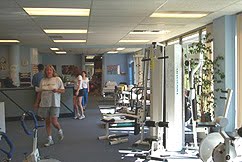 True to my expectations, the private physiotherapy clinic was not geared to treating patients with brain injuries, spinal cord injuries strokes or other major neurological tramas, but rather specialized in treating sports jocks and people with community acquired strains and sprains. That said, I found them to be quite professional and dedicated. The atmosphere and staff were welcoming and although the therapy sessions were a half hour each, I was never rushed and allowed to walk and use exercise equipment as long as I wished - usually dictated by by my scheduled ride home.
*(photo is of my physiotherapy clinic's gym. Gives some idea of the distance walked)
The half hour physiotherapy included a variety of stretches including hamstring, Achilles, and piriformis. I also recived further instructions on exercises I could do at home. Early in the new year of 2010, once a week massage therapy was added to the twice a week physiotherapy regime. Cost was paid for out of pocket but later reimbursed by my private insurance plan.
So what was accomplished in this half year of private physiotherapy?
- on the first day of therapy my physiotherapist performed a piriformis muscle stretch and the spasm that it generated almost threw her across the room. The spasms quickly subsided during subsequent visits & stretches however, after a winter of receiving the stretches, the increase in range and reduction of spasms has not translated into reduced sciatic pain. It continues as unpredictable and intense as ever. The links provided shows a technique in performing the stretch that differs from how I received mine. I lay prone on a table/bench while the physiotherapist braced with her hand around my hip while pulling my leg outwards like the handle on a slot machine.

- the range of my hamstrings is now about what would be considered normal, or pre-injury. The Achilles stretches were discontinued early on as the diminutive physio's physical effort was insufficient to be effective. (ie. I'm a big guy and she was a rather small young lady.) My own weight & repeated standing, whenever able during the day, was no doubt more effective than any force she could apply. Regardless, no matter how much I stretch the Achilles, I find that they tend to rebound to a tight state very quickly. The stretch doesn't last, perhaps due to the 'tone' I spoke of a few posts earlier. Early in January, I received another set of BoTox injections to the gastrocs and soleus muscles in hopes of reducing the tightness which prevents me from getting my heels down and not tilting backwards when standing. Although my physio thought she felt a slight amount of increased range right after injection, the amount she detected was minimal, nor did she feel the effects lasted very long. I felt very little change internally though after the effectiveness of the Botox wears off after about 3-4 months (due to the regrowth of the peripheral muscles targeted), I once again may have noticed a slight deterioration of my gait. (ie. walking was not as fluid and smooth). I now have to decide whether its worthwhile in getting future injections.
- laser therapy was applied to my hip and sciatic nerve area in hopes of lessening the pain however, in the end, I feel it had no effect, even temporary.
- Walking - core strength has improved which allows me to walk in an upright position and not lean heavily on the walker. In fact I can lift the walker off the ground while standing however I'm still unable shift weight to one leg while lifting the other foot, as in stepping, without the support of the walker. I don't have the measurements of the gym, however I graduated from walking the full length and back some 6 times when I first arrived to 25 to 30 times when I concluded last week. My stopping was due more to my time running out as my scheduled ride neared, than to fatigue. From full paralysis in 2006 to walking with a walker in 2010, I have yet to stumble and fall to the ground - a record I hope to keep.
- I used an apparatus where I could lift weights with my legs or switch the configuration to pull the weight downward with the hamstrings. This improved the muscle mass and strength in the hamstring muscles and quads. In the end I was doing about 50 repetitions of 100 pounds each session - twice a week.
- Massage therapy was started in January. Although advised by my BoTox physiatrist that it would be of little use and that I should save my money, I thought it was worth a shot anyways. During my post-injury recovery, my calf muscles have become rock-hard probably due to the tone - the very tightness which the BoTox had little effect on. More recently, I've noticed that my legs get very cold to the touch, especially at night (I don't feel cold, but the legs are noticeably cold to the touch). This again is probably due to the 'tone' - the brain telling muscles to clench which now constricts blood vessels and blood flow to the limbs (legs) affected. It appears that the doctor was correct as the legs remain very hard and tight even after my massage therapy coverage was exhausted. The massage was not restricted to my legs but also applied to stretching out and treating the lower back and piriformis muscles in an attempt to reduce the sciatic nerve pain. In the end I find myself undecided on the effectiveness. Some days post-massage I feel I have some relief, then again other days the pain that follows is as intense and as frequent as ever.
The future? As I entitled this post, 'Spring & Summer Regime', it is now up to me to prepare a schedule and find a suitable location to practice walking and build on the endurance I gained at the physiotherapy clinic. With better weather, I can venture outside along sidewalks, in local parks or in shopping malls when crowds have dissipated. Structured physiotherapy provided the incentive to attend bi-weekly. Now it is up to me to find the discipline to continue walking on a daily basis. Wish me luck!
Sunday, 21 February 2010
Work As Therapy
In the previous post I spoke of how the muscle tension or tightness referred to as 'tone' cannot be reversed or even reduced to any great degree by exercise or stretching out. Regardless, I have notice some increased flexibility and range of motion after having returned to work.
In exercising you are usually given a motion which you repeat in say three sets of ten. Lift your leg up and down 10 times, rest, then repeat, etc. The motion is usually unidirectional (up and down - in-line and for a duration of usually minutes).
Having returned to work and an 8 hour workday, I find myself having to move through a wide range of motions continuously. Reaching for items I need, twisting at the torso, swiveling, stretching, grasping, bending - to the left, to the right, up and down. The continuous motions required are so much more than one can get during an hour in physio or at home, held captive by your TV.
Some increased motion range and flexibility has been noted. In addition I've had the occasional sensation I refer to as 'micro-tears' in my back which I believe are the adhesions breaking up or releasing. As discussed in a previous post I believe these adhesions are bonds formed between the various layers of tissue during the time of non-use or restricted use. Tissue layers normally slide smoothly across one another when stretching however, when paralyzed and movement does not occur for any length of time, the tissue components begin to bond to the adjacent layers. If and when motion returns the feeling might be analogous to two surfaces sliding against each other without any lubricant or grease to make the movement glide smoothly. With muscles I feel this sticky, ratcheting sensation where the muscle feels as if it alternately and rapidly slides, sticks, slides and sticks again. When walking I can feel sheaths of muscles move within the leg. In the back I have some of the same sensation but sometimes when extending some motion I have a momentary twinge - where I feel a minute tear as one of the adhesions releases.
In summation, I feel that the increased exertion and range of motion required in my workplace has translated into greater range of motion in my own movements. Tone will always be present in the muscles affected and will always oppose any attempt for the muscles to return to a normal 'pre-injury' state.
Again, these observations are not scientific, and explainations may not be totally accurate, but they are impressions that I have based on my own experience.
In exercising you are usually given a motion which you repeat in say three sets of ten. Lift your leg up and down 10 times, rest, then repeat, etc. The motion is usually unidirectional (up and down - in-line and for a duration of usually minutes).
Having returned to work and an 8 hour workday, I find myself having to move through a wide range of motions continuously. Reaching for items I need, twisting at the torso, swiveling, stretching, grasping, bending - to the left, to the right, up and down. The continuous motions required are so much more than one can get during an hour in physio or at home, held captive by your TV.
Some increased motion range and flexibility has been noted. In addition I've had the occasional sensation I refer to as 'micro-tears' in my back which I believe are the adhesions breaking up or releasing. As discussed in a previous post I believe these adhesions are bonds formed between the various layers of tissue during the time of non-use or restricted use. Tissue layers normally slide smoothly across one another when stretching however, when paralyzed and movement does not occur for any length of time, the tissue components begin to bond to the adjacent layers. If and when motion returns the feeling might be analogous to two surfaces sliding against each other without any lubricant or grease to make the movement glide smoothly. With muscles I feel this sticky, ratcheting sensation where the muscle feels as if it alternately and rapidly slides, sticks, slides and sticks again. When walking I can feel sheaths of muscles move within the leg. In the back I have some of the same sensation but sometimes when extending some motion I have a momentary twinge - where I feel a minute tear as one of the adhesions releases.
In summation, I feel that the increased exertion and range of motion required in my workplace has translated into greater range of motion in my own movements. Tone will always be present in the muscles affected and will always oppose any attempt for the muscles to return to a normal 'pre-injury' state.
Again, these observations are not scientific, and explainations may not be totally accurate, but they are impressions that I have based on my own experience.
Saturday, 20 February 2010
Tone
Tone
 No, not that knob on your guitar or stereo system. Not even the reference to "toned" athletes or body builders. No, I'm referring to 'Paralytic Tone'.
Shortly after coming out of my post surgical 'fog', I noticed a tremendous discomfort bordering on pain whenever I coughed. It felt as if my chest was wrapped with elastic bands. Could my muscles have deteriorated and shortened in such a short time post injury? A half year later, after I began to regain voluntary movement, I noted that the tightness remained. I thought that those muscles that had not been used over the last six months would now stretch out with my increasing movement. I had mentioned this tightness to various health care professionals/physiotherapists in hopes of obtaining specific exercises to counter this unpleasant tension. No exercises or explanations were offered however I noticed the word 'tone' used when talking of my condition. Internet searches offered little more.
My simplistic understanding, which I gathered over time was that when the spinal cord is damaged, the injury causes the brain to send signals (whether different or increased) to the muscle groups involved and tells them to contract or clench more that in the uninjured state. As a result, the muscles are continuously 'turned on' to a greater degree and the resulting tension is referred to as 'Tone' or 'Paralytic Tone'. (My apologies to any Neurophysiologists out there as a proper explanation was never clear or forthcoming from my health care providers.) The result is this continuous tightness in the muscle groups controlled from the injured area of the spinal cord. As my injury level was at T-5, the damage was high enough up to cause my thoracic (chest) muscles to continuously clench. The result is this sensation of having my rib-cage wrapped in rubber. The sensation is outside of the ribs so breathing is unimpeded. The tightness is most noticeable on rising in the morning and although it can be somewhat loosened with stretching, it never approaches feeling normal and re-tightens quickly if I relax for any period of time. The tightness is most noticeable when twisting at the torso, reaching and when those rib cage muscles are stretched to their limit with a very deep inhalation.
In my situation, this tone presents itself the most around my chest and in my calves (gastrocs & soleus muscles) although I suspect it applies to every muscle group below my injury level. The calf muscles are so tight they pull on the achillie's tendon making it difficult for me to keep my heels on the ground. When standing, if not stretched out beforehand, the raised heels have me tipping backwards. This is what the Botox was suppose to address but again, my current physiotherapist feels that the toxin had done very little to block the nerves activating these muscles and have them relax to where my heels come down and my stance is more normal. Even with the Botox, my calves are as hard as petrified wood- repeated stretches and increaced walking have not loosened them and I]ve had too few massage sessions to see if this therapy might loosen them to any degree. As mentioned in an earlier post, my physiatrist (Doctor) claims that studies have never shown massage therapy to have positive effect on 'tone' tension.
It is my belief that this very 'tone' muscle tension is responsible for my sciatic nerve pain. Even after extensive physiotherapy and exercising it seems when I purposely tighten or clench my muscles, my left lower back seems to tighten more vigorously than the right. This asymmetrical response is probably due to the initial injury not being entirely symmetrical and with greater 'tone' on the lower left back muscles, the increased tension pulls my left hip out of alignment. It seems that however much I exercise and stretch out those muscles, the permanent 'tone' always pulls them back out of place to aggravate the sciatic nerve.
So, this constant tightness is a direct result of the injury and resists any attempt to be stretched out. Any give that occurs through exercise or stretching quickly retracts when resting. The drug Baclofen is taken to minimize this tightness and has some effect. While I'm not at the maximum dosage, I take enough drugs and don't wish increase this concentration and add to the chemical soup already in my system.
I now recognize that the condition is permanent and that both the sciatic nerve pain and the neurogenic pain are to be endured daily for the remainder of my life.
Saturday, 6 February 2010
Dumb Ass
Well, I really am a dumb ass. Been thinking about having my van converted so I have more freedom, not having to rely on public disability transportation. Just occurred to me that if I had applied before returning to work I could have cried poverty, declared that I was a poor cripple, and applied for assistance in the costly makeover or new purchase. (dropped floor, ramp/lift, hand controls, etc.) - but nnnnooooooo, lets fight this disability and get back to work. Now that I'm no longer on disability pay and once again employed full time, I'm certain that I'll be turned down for any assistance that might make the price renovation a little easier to deal with. Duhhh!
Friday, 5 February 2010
Wheelchair Etiquette
Wheelchair Etiquette
 Waiting for my public 'disability transport' to arrive, I have ample time to observe people's behaviour in and around the hospital where I work. One thing that I've observed and absolutely drives me crazy is the lack of courtesy some people exhibit. At this point I won't even get into people ignoring wheelchairs sharing their world, letting doors slam on me, walking on the wrong side of the hallway (convention has it that you walk on the same side you drive), refusing to give right of way to a wheelchair which is harder to maneuver, people shooting out of doors without watching for others, able body people refusing eye contact - staring above and over you and your chair, ignoring requests of "excuse me", and on and on...
This rant is about one issue. Several times now I've witnessed an able bodied person wheeling a family member out to a waiting car using a hospital wheelchair. After tenderly putting their loved one in the automobile, they turn and push (or worse yet, kick) the manual chair in the general direction of the hospital entrance - then drive off.
Trouble is, its snowing outside and that chair will be frozen and wet with snow when the next person is looking for a chair to assist their friend or family member.
People, if God has graced you with good health, use those legs that I wish I could to roll the chair back into the hospital entrance and dock it where it is kept so that others might enjoy a clean & dry chair without searching for it!!!
Odds & Ends
1- Had a third series of Botox injections two weeks ago and hoped that this would aid the tightness in the calf muscles to allow better movement/range from the ankle.
Now, when I had the first two series of Botox injections, the physiotherapists were concentrating on getting me up and walking - with the hope that Botox would improve my stride. They didn't check for range of motion pre and post injection to see if there was greater range and flexibility. Internally I did not notice any change in sensation nor any increase in range from my perspective. As the effects of Botox were to last about 3-4 months, before blocked nerves regenerated and formed new pathways, the only feedback I had regarding the effects of Botox therapy was what I thought was a shortening of my stride as the next injection date approached. My Physio and I thought that this was probably due to new connections circumventing the Botox blockage and therefore the Botox was effective.
Now that I am upright and able to walk for periods of time, my new physio was concentrating on various manipulations to my limbs such as stretching out the quads and hamstrings as well as the piriformis muscle (but more on that one later). As she was directly observing and working on the range of motion of my lower limbs, she was interested in seeing exactly how much more range the Botox therapy provided after a series of injections to the Soleus and Gastroc muscles (basically the two calve muscles joining to the achilles.
As it turned out, she said that there was an increace in flexibility and range a day after I received the injections, however now after only a week has passed, she no longer detects that change even with the increased therapy. Could the Botox really be that ineffective for me? If so, I really have to reconsider whether to take any more shots in the future.
2- As mentioned, I'm back to the Gabapentin from the Lyrica as in the end I felt the Lyrica had no greater effect that the Gabapentin, had fewer side effects (for me blurred vision and probable weight gain) and was less expensive which would please my private supplemental health insurance carriers.
3- Also as mentioned, I'm walking more at the physiotherapy clinic though still somewhat unsteady. Have to improve on the core muscle stability as the muscles, particularly the lower back, tire quickly. Trying to regain that link - feedback from the feet on the floor, telling the brain what's happening and subsequent messages from the brain telling the muscles how to perform to correct, compensate and maintain balance while upright. Since standing for the very first time, post injury, I still have not fallen to the floor once.
4- Tone- not the tone that athletes & body builders speak of when they say an athlete is really "toned", but rather refers to the increased tightness, post spinal cord injury, where the communication between the damaged cord and the brain, tells the brain to clench or tighten. Baclofen is supposedly prescribed to lessen this signal and reduce the tightness experienced.
In my case, I believe, (I believe, because meaningful feedback from therapists and doctors is sadly lacking) - In my case, I believe that because the injury is not quite symmetrical, one part of my spinal cord received more or different damage that another. As a result there is greater 'tone' on my left back muscles than the right resulting in a greater pull or tension on the left. It is also my belief that this results in my left side pulling more on the muscles attached to the hip and this asymmetrical pull results in my sciatic nerve pain. A tremendously painful affliction which is bothersome even when not sitting. On my stomach the nerve throbs with pain with every pulse and heartbeat. A truly maddening situation. On the few good days it is noticeable but tolerable. On bad days it is excruciatingly painful, drawing one's attention to it ever minute or so. Something I've endured for three years and no health care professional has offered any advice other than to "learn to live with it". Yeah, right!
This new physiotherapist has at least attempted to stretch out the piriformis muscle with a manipulation akin to grabbing my leg by the ankle and while bracing with one hand on my hip, pulling the leg out sideways. When she first attempted this on my weaker (painful) side, the resulting spasms were so great the I thought the recoil was going to kick her in the teeth. However, within days the spasms lessened to where now she can pull through just about a full normal range with only a slight shudder on a very few stretches, I do believe this has helped the pain. Although a bit tender the day after the therapy, I get a couple of good days afterwards. For how long, I'm not sure as I'm back in physio receiving that stretch and subsequent post physio tenderness the day after. Not sure how long the relief might last however as the tone is always there, the hip will most likely be pulled out of alignment once more.
5- Low Level Laser Light Therapy. Not sure if this is revolutionary or just plain Voodoo science but I've had a few sessions with laser therapy in an attempt to help my sciatic nerve pain. Can't quite see how it would help in my situation. I understand the premise is that the laser light somehow alters the cellular biochemistry at the site it is applied thereby increasing healing. (very oversimplified). But I just can't see how shining light on my butt will cure a pain that is much more deep seated (no pun intended). Therapy consists of placing these light emitting panels under my shorts, positioned against the skin at the afflicted site. The laser is turned on for six minutes after which a different panel is inserted (different intensity?, frequency???) for another six minutes. There is no sensation associated with the therapy (ie. no heat, pulse, pain etc.) After about 4-5 sessions now, I notice no difference, however I notice very little change from any of the therapies except possibly the stretching of the piriformis muscle. Nerve still hurts but doesn't spasm as much. Laser therapy was included as part of the physiotherapy session.
6- My physiotherapist suggested I try massage therapy once again to loosen up the legs and perhaps increase circulation. I passed the issue by my physiatrist (Doctor), specializing in spinal cord injuries however he stated that there are no studies suggesting that massage therapy aids this tightness. The 'tone' will always be there - it cannot be shut off but only controlled with doses of Baclofen. It was my impression that he believed that the tone would simply undo, or fight any improvement the massage therapy might offer, negating any gains almost immediately. As my private insurance does cover limited sessions of massage therapy, I though I'd give it a try because;
Phyisotherapy twice a week after work for an hour to hour & half and Massage therapy once a week for a half hour. 12 hour days! Pain at times is unbearable and not much to look forward to can really mess with the mind.
Now, when I had the first two series of Botox injections, the physiotherapists were concentrating on getting me up and walking - with the hope that Botox would improve my stride. They didn't check for range of motion pre and post injection to see if there was greater range and flexibility. Internally I did not notice any change in sensation nor any increase in range from my perspective. As the effects of Botox were to last about 3-4 months, before blocked nerves regenerated and formed new pathways, the only feedback I had regarding the effects of Botox therapy was what I thought was a shortening of my stride as the next injection date approached. My Physio and I thought that this was probably due to new connections circumventing the Botox blockage and therefore the Botox was effective.
Now that I am upright and able to walk for periods of time, my new physio was concentrating on various manipulations to my limbs such as stretching out the quads and hamstrings as well as the piriformis muscle (but more on that one later). As she was directly observing and working on the range of motion of my lower limbs, she was interested in seeing exactly how much more range the Botox therapy provided after a series of injections to the Soleus and Gastroc muscles (basically the two calve muscles joining to the achilles.
As it turned out, she said that there was an increace in flexibility and range a day after I received the injections, however now after only a week has passed, she no longer detects that change even with the increased therapy. Could the Botox really be that ineffective for me? If so, I really have to reconsider whether to take any more shots in the future.
2- As mentioned, I'm back to the Gabapentin from the Lyrica as in the end I felt the Lyrica had no greater effect that the Gabapentin, had fewer side effects (for me blurred vision and probable weight gain) and was less expensive which would please my private supplemental health insurance carriers.
3- Also as mentioned, I'm walking more at the physiotherapy clinic though still somewhat unsteady. Have to improve on the core muscle stability as the muscles, particularly the lower back, tire quickly. Trying to regain that link - feedback from the feet on the floor, telling the brain what's happening and subsequent messages from the brain telling the muscles how to perform to correct, compensate and maintain balance while upright. Since standing for the very first time, post injury, I still have not fallen to the floor once.
4- Tone- not the tone that athletes & body builders speak of when they say an athlete is really "toned", but rather refers to the increased tightness, post spinal cord injury, where the communication between the damaged cord and the brain, tells the brain to clench or tighten. Baclofen is supposedly prescribed to lessen this signal and reduce the tightness experienced.
In my case, I believe, (I believe, because meaningful feedback from therapists and doctors is sadly lacking) - In my case, I believe that because the injury is not quite symmetrical, one part of my spinal cord received more or different damage that another. As a result there is greater 'tone' on my left back muscles than the right resulting in a greater pull or tension on the left. It is also my belief that this results in my left side pulling more on the muscles attached to the hip and this asymmetrical pull results in my sciatic nerve pain. A tremendously painful affliction which is bothersome even when not sitting. On my stomach the nerve throbs with pain with every pulse and heartbeat. A truly maddening situation. On the few good days it is noticeable but tolerable. On bad days it is excruciatingly painful, drawing one's attention to it ever minute or so. Something I've endured for three years and no health care professional has offered any advice other than to "learn to live with it". Yeah, right!
This new physiotherapist has at least attempted to stretch out the piriformis muscle with a manipulation akin to grabbing my leg by the ankle and while bracing with one hand on my hip, pulling the leg out sideways. When she first attempted this on my weaker (painful) side, the resulting spasms were so great the I thought the recoil was going to kick her in the teeth. However, within days the spasms lessened to where now she can pull through just about a full normal range with only a slight shudder on a very few stretches, I do believe this has helped the pain. Although a bit tender the day after the therapy, I get a couple of good days afterwards. For how long, I'm not sure as I'm back in physio receiving that stretch and subsequent post physio tenderness the day after. Not sure how long the relief might last however as the tone is always there, the hip will most likely be pulled out of alignment once more.
5- Low Level Laser Light Therapy. Not sure if this is revolutionary or just plain Voodoo science but I've had a few sessions with laser therapy in an attempt to help my sciatic nerve pain. Can't quite see how it would help in my situation. I understand the premise is that the laser light somehow alters the cellular biochemistry at the site it is applied thereby increasing healing. (very oversimplified). But I just can't see how shining light on my butt will cure a pain that is much more deep seated (no pun intended). Therapy consists of placing these light emitting panels under my shorts, positioned against the skin at the afflicted site. The laser is turned on for six minutes after which a different panel is inserted (different intensity?, frequency???) for another six minutes. There is no sensation associated with the therapy (ie. no heat, pulse, pain etc.) After about 4-5 sessions now, I notice no difference, however I notice very little change from any of the therapies except possibly the stretching of the piriformis muscle. Nerve still hurts but doesn't spasm as much. Laser therapy was included as part of the physiotherapy session.
6- My physiotherapist suggested I try massage therapy once again to loosen up the legs and perhaps increase circulation. I passed the issue by my physiatrist (Doctor), specializing in spinal cord injuries however he stated that there are no studies suggesting that massage therapy aids this tightness. The 'tone' will always be there - it cannot be shut off but only controlled with doses of Baclofen. It was my impression that he believed that the tone would simply undo, or fight any improvement the massage therapy might offer, negating any gains almost immediately. As my private insurance does cover limited sessions of massage therapy, I though I'd give it a try because;
- my doctors have been wrong in the past, numerous times
- each person responds differently to therapy
- the cost is covered and the therapy can't hurt
- it may aid circulation if not the tightness from 'tone'
Phyisotherapy twice a week after work for an hour to hour & half and Massage therapy once a week for a half hour. 12 hour days! Pain at times is unbearable and not much to look forward to can really mess with the mind.
Sunday, 17 January 2010
Back to Gabapentin From Lyrica
January 2009 - Nerve pain is as severe as ever. Intense burning from just below the knees to the toes. A cross between burning and 'pins and needles' or perhaps if your limbs were submersed in very hot soda water with the thousands of bubbles bursting as 'pin-pricks' each and every second of each day of the year. There is that constant tingling element to it.
With my latest prescription renewal I abandoned my experiment with Lyrica and have gone back to Gabapentin although neither did much, if anything for the nerve pain. The Lyrica distorted my vision and induced sleepiness. Gabapentin is cheaper than Lyrica and although covered by my private insurance so I guess it's preferable to take an ineffective drug that has less side effects and doesn't erode the profits of the insurance company's CEOs.
I continue to take the medication simply because I feel as if I'm doing something, even if not very effective.
With my latest prescription renewal I abandoned my experiment with Lyrica and have gone back to Gabapentin although neither did much, if anything for the nerve pain. The Lyrica distorted my vision and induced sleepiness. Gabapentin is cheaper than Lyrica and although covered by my private insurance so I guess it's preferable to take an ineffective drug that has less side effects and doesn't erode the profits of the insurance company's CEOs.
I continue to take the medication simply because I feel as if I'm doing something, even if not very effective.
Voluntary Brain Disease
No Brain Spammers
 Paraplegia may result by several pathways, the usual being damage to the spinal cord or brain injury. While both are debilitating, perhaps the saddest injury of all is that of voluntary brain disease. The world is full of brainless morons who decide to display their self inflicted idiocy at every opportunity. Like a dog that has to raise it’s leg and piss on every post it passes, spammers have found their way to this blog and began daily postings submitted as comments.
My hope was that someone might benefit from my experiences and I welcomed shared discussion and legitimate comment and feedback on my posts. However, as of late I’ve received ever increasing posts of nonsensical babblings, come-ons, and self serving links to unrelated products and topics.
As a result of these idiot spammers, I’ve found it necessary to instigate ‘word verification’ in order to reduce the messages posted by ‘bots’. Those idiots who have more time than brains and post personally, I will continue to delete their spam immediately as they may appear.
It’s tragic that idiots voluntarily give up their brains in order to feed spam to the uninterested masses.
Get a life!
Saturday, 16 January 2010
Tell Me Again Why I Need A Doctor…

Sometimes I wonder how the medical profession has really helped me.
Just a few examples although others exist.
1980 (December) - Just out of University and having found part-time employment in medical related research, I began experiencing severe and debilitating ‘attacks‘. Attacks so sudden and severe that at each episode (usually daily), I thought I was surely going to die. Doctors (at least 3) could not provide a diagnosis nor offer effective treatment. Various sedatives and tranquilizers were prescribed with no effect - the attacks continued. This went on for 5 years, until 1985 when I became aware of a particular prescription drug as well as a ‘source’ for it. Conducting my own experiment, I took the drug and almost immediately the attacks stopped. I approached my doctor about having the drug, a mild anti-depressant, prescribed legitimately to which he agreed. I never again experienced those ‘attacks’ which now the medical community refer to as “anxiety attacks”. Years later I find I no longer need the prescription but I lost five years of my life to a living hell in the interim. Thanks Doc…
2006 (April) - Severe back pain from what I believed was a sprained back (probably started that way). With my doctor having recently given up his practice, I had yet to find a new family physician. Went to a ‘Walk-In Clinic’ to see a doctor. No examination or tests, just received a prescription for an analgesic (pain pills) and a muscle relaxant. By the end of the month I became a paraplegic due to a Staphylococcal infection on the spinal cord. Thanks Doc…
2006 (May through December) - While in the hospital my left ear plugged up to where I was virtually deaf on that side. Pushing behind the earlobe where the eustachian tube runs all I could hear was a watery squishing sound. Three doctors over two institutions examined my ear with a otolaryngoscope declared me healthy. They found no problem although I continued to remain deaf. Months later, on my discharge from the hospital I obtained some cotton balls soaked in hydrogen peroxide and kept infusing the fluid into my ear. Within days large amounts of dark material began to ooze out of the ear canal and as it lessened, my hearing returned. Thanks Doc…
2007- present - severe burning neurogenic (nerve) pain from the injury sustained in 2006. Told by each doctor that nothing can be done to relieve this particular type of pain other than the ineffective drugs already taken. Told to live with it - nothing can be done. Thanks Doc…
Sciatic nerve pain from some muscle imbalance resulting from the same injury. Told by various doctors that nothing can be done. On describing the pain to one doctor, his response was to tell me in some detail about his own bout with sciatic nerve pain. That makes me feel better, thanks Doc…
Other than the doctor that slapped my ass when I came into this world, and perhaps the one who neurosurgeon who performed my back surgery(1) , I can’t think of how my health has been better by being in the care of these professionals.
* * *
Remember - out ever every graduating class of new doctors, someone finished at the bottom of their class. Doctors are human too and have all the frailties that the general population has.(1) Still wonder why I could move my toes right after surgery but not later in my recovery.
Thanks Doc...
Sunday, 10 January 2010
Physiotherapy “Lite”
Physiotherapy “Lite”
With Ontario (Canadian) hospitals experiencing major operational funding challenges, most institutions have, through their own Board of Directors and/or government agencies (1) pared down the services offered. In April of 2008 the ‘private/self pay’(2) arm of the hospital physiotherapy department I was attending, closed it’s doors. The reasoning was that ‘private/self pay’ services were available in the community and therefore it would be redundant for the hospital to continue offering these services.
To preserve the continuity of my therapy, I was transferred to the OHIP (3) arm of the hospital physiotherapy department allowing me to continue treatment uninterrupted for another 16 weeks. (Shhhhh - As an employee of that same hospital, I believe this was done as a professional favour)
As September approached, I found myself discharged from the hospital physiotherapy program as the self pay service was no longer offered and I had exhausted my limit on the government funded plan. Also with September’s arrival, I returned to my job at that very hospital at which I could no longer receive therapy. (It would have been so convenient for me to be able to continue therapy during lunch hour or after work had the service continued.)
After having eased my way back into the working world and with winter fast approaching, I went in search of a community physiotherapy clinic where I might continue therapy, particularly practicing walking with a walker. My goal was to regain leg & core muscle strength along with better balance providing me the stability and resulting confidence to venture out on my own neighbourhood sidewalks once summer returned.
My options were either to take the public disability transit bus (TransHelp) to some clinic in the community right after work or to find a clinic close enough to work that I could motor over with my wheelchair right after work eliminating at least one, often lengthy wait or bus ride there and home again afterwards. Although grateful for the bus service offered the wait and trips often add 2 hours to my 8 hour workday. With an hour of physiotherapy twice a week, my day away from home frequently comes closer to 12 hours. A long time to sit!
I did find a private/community physiotherapy clinic in a ‘Professional Building’ across the hospital parking lot and decided to give them a try if for nothing more than convenience. Convenience in not having to take another bus trip however wheelchair navigation to the building had me crossing a busy roadway at the end of shift with hospital employees eager to leave the grounds. Crossing a torn up parking lot in the midst of renovation the professional building has a narrow ramp and double actuated swing doors leading into the foyer. Inside the six story building, the two public elevators are so small that they will accommodate my chair and perhaps two other persons. The chair can barely turn around inside the elevator cab. One floor down (basement) the physiotherapy clinic does not have an automatic door opener and I find it a struggle to enter the corner of the waiting room with chairs lining the walls at right angles along both sides. (I usually end up taking a chair or two with me as I enter!)
It was always my fear that in spite of the claims of “redundancy”, the private community clinics might not be able to provide the therapy and expertise that can be offered in a hospital setting. Right away I notice that much of the equipment that was instrumental in freeing me from having to be hoisted out of a bed/chair with a lift was nowhere to be seen. No tilt tables, no sit-to-stand units, no parallel bars - not even an aluminum frame walker was to be found. While a hospital physio clinic has to be prepared to offer therapy to traumatic spinal cord injuries, brain injuries, strokes and such, the private clinic seems to concentrate on jocks who have sports related injuries, minor automobile & workplace related injuries and perhaps women who have fallen off of their high-heel shoes. Clientele is different so supporting equipment and expertise is different.
After an initial assessment, the physiotherapist thought she could assist me in the goals I had set and we mutually decided to give it a try. I would come over after work about twice a week as our schedules permitted.
The physiotherapy clinic rented a frame walker for my use (as my own would be too cumbersome to bring along) and therapy began in mid-October. We shall see…
* * *
(1) It is my understanding that the decision to discontinue various therapies or close departments is made by the hospital administrators (C.E.O.s & Board of Directors) in conjunction with L.H.I.N.s (Local Hospital Integration Network), a government “arms length” agency brought in to slash operational costs (and subsequent government funding) yet deflecting the wrath of the public from the politicians). Rural hospital emergency departments and medical clinics have been forced to close angering affected residents as they have to drive greater distances for essential services.
(2) Private/Self Pay Clients - Community hospital’s mandates were originally to provide medical services to all residents of a particular community, often in one integrated and convenient location. These services were offered to both ‘Inpatients’ and ‘Outpatients’ covered under the government health plan. For extended, additional or elective therapy covered by one’s private insurance provider, or out of one’s own pocket, an additional branch of the department might cover these ‘Private/Self Pay’ outpatient clients.
(3) O.H.I.P. - Ontario Hospital Insurance Plan - our provinces government funded social health insurance. My original hospital stay, surgery, physiotherapy and just about everything ‘in hospital’ was covered by the government plan. Once I had been patched up and discharged, I was entitled to limited physiotherapy on the government plan, or additional continuing physiotherapy as my private insurance permitted. My good fortune was that I was entitled to unlimited physiotherapy in the plan my employer had negotiated with it’s private insurance carrier.
With Ontario (Canadian) hospitals experiencing major operational funding challenges, most institutions have, through their own Board of Directors and/or government agencies (1) pared down the services offered. In April of 2008 the ‘private/self pay’(2) arm of the hospital physiotherapy department I was attending, closed it’s doors. The reasoning was that ‘private/self pay’ services were available in the community and therefore it would be redundant for the hospital to continue offering these services.
To preserve the continuity of my therapy, I was transferred to the OHIP (3) arm of the hospital physiotherapy department allowing me to continue treatment uninterrupted for another 16 weeks. (Shhhhh - As an employee of that same hospital, I believe this was done as a professional favour)
As September approached, I found myself discharged from the hospital physiotherapy program as the self pay service was no longer offered and I had exhausted my limit on the government funded plan. Also with September’s arrival, I returned to my job at that very hospital at which I could no longer receive therapy. (It would have been so convenient for me to be able to continue therapy during lunch hour or after work had the service continued.)
After having eased my way back into the working world and with winter fast approaching, I went in search of a community physiotherapy clinic where I might continue therapy, particularly practicing walking with a walker. My goal was to regain leg & core muscle strength along with better balance providing me the stability and resulting confidence to venture out on my own neighbourhood sidewalks once summer returned.
My options were either to take the public disability transit bus (TransHelp) to some clinic in the community right after work or to find a clinic close enough to work that I could motor over with my wheelchair right after work eliminating at least one, often lengthy wait or bus ride there and home again afterwards. Although grateful for the bus service offered the wait and trips often add 2 hours to my 8 hour workday. With an hour of physiotherapy twice a week, my day away from home frequently comes closer to 12 hours. A long time to sit!
I did find a private/community physiotherapy clinic in a ‘Professional Building’ across the hospital parking lot and decided to give them a try if for nothing more than convenience. Convenience in not having to take another bus trip however wheelchair navigation to the building had me crossing a busy roadway at the end of shift with hospital employees eager to leave the grounds. Crossing a torn up parking lot in the midst of renovation the professional building has a narrow ramp and double actuated swing doors leading into the foyer. Inside the six story building, the two public elevators are so small that they will accommodate my chair and perhaps two other persons. The chair can barely turn around inside the elevator cab. One floor down (basement) the physiotherapy clinic does not have an automatic door opener and I find it a struggle to enter the corner of the waiting room with chairs lining the walls at right angles along both sides. (I usually end up taking a chair or two with me as I enter!)
It was always my fear that in spite of the claims of “redundancy”, the private community clinics might not be able to provide the therapy and expertise that can be offered in a hospital setting. Right away I notice that much of the equipment that was instrumental in freeing me from having to be hoisted out of a bed/chair with a lift was nowhere to be seen. No tilt tables, no sit-to-stand units, no parallel bars - not even an aluminum frame walker was to be found. While a hospital physio clinic has to be prepared to offer therapy to traumatic spinal cord injuries, brain injuries, strokes and such, the private clinic seems to concentrate on jocks who have sports related injuries, minor automobile & workplace related injuries and perhaps women who have fallen off of their high-heel shoes. Clientele is different so supporting equipment and expertise is different.
After an initial assessment, the physiotherapist thought she could assist me in the goals I had set and we mutually decided to give it a try. I would come over after work about twice a week as our schedules permitted.
The physiotherapy clinic rented a frame walker for my use (as my own would be too cumbersome to bring along) and therapy began in mid-October. We shall see…
* * *
Due to government regulations, the private physiotherapy clinic is not allowed to bill my private insurance company directly for services rendered. Patient confidentiality or some other such nonsense. Unlike the hospital physiotherapy clinic which submitted claims on by behalf, I must pay the private physiotherapy clinic for each session, accumulate the receipts for whatever time I determine, then submit the invoices personally (by mail) for reimbursement at yet a later date. Does make a dent in the credit card balance prior to reimbursement.
* * *
(2) Private/Self Pay Clients - Community hospital’s mandates were originally to provide medical services to all residents of a particular community, often in one integrated and convenient location. These services were offered to both ‘Inpatients’ and ‘Outpatients’ covered under the government health plan. For extended, additional or elective therapy covered by one’s private insurance provider, or out of one’s own pocket, an additional branch of the department might cover these ‘Private/Self Pay’ outpatient clients.
(3) O.H.I.P. - Ontario Hospital Insurance Plan - our provinces government funded social health insurance. My original hospital stay, surgery, physiotherapy and just about everything ‘in hospital’ was covered by the government plan. Once I had been patched up and discharged, I was entitled to limited physiotherapy on the government plan, or additional continuing physiotherapy as my private insurance permitted. My good fortune was that I was entitled to unlimited physiotherapy in the plan my employer had negotiated with it’s private insurance carrier.
Saturday, 9 January 2010
Re-evaluating Nerve Pain & Pain Medication
Re-evaluating Nerve Pain & Pain Medication
 It has been 3 years almost to the day that the inflammation in my back from the initial infection and subsequent surgery subsided. A two-way street, so to speak, as it allowed both signals through to regain motion in my legs but also the signal of pain to be my constant companion from mid-January, 2007 to present.
Burning, searing pain that is a cross between sensations of ‘burning' and ‘pins & needles’. Or perhaps a constantly fluctuating sensation as if my limbs were immersed in very hot club soda (soda-water) with painful effervescent bubbles rapidly bursting along those limbs.
Initially prescribed 300 mg of Gabapentin three times a day along with 25 mg of Nortriptyline once per day, I felt that there was little if any relief yet lived with that pain for about 2 &½ years.
About a half year ago I persuaded my doctor to prescribe Lyrica (Pregabalin) as an alternative to the Gabapentin. It is my understanding that Lyrica was “stronger” and therefore a lower concentration was needed to achieve relief. I started at 25 mg three times per day for 3 months and at first I thought that I did notice an immediate slight reduction of neurogenic (nerve) pain. However, I now believe that was simply a coincidence - for whatever reason I had a slightly better weekend after changing to Lyrica. Within days the pain seemed to be as before (or at least my perception of it was) and the constantly searing and distracting pain was as before.
On renewal I asked my doctor to double the dosage to 50 mg three times daily (It is my understanding that some people can tolerate as much as 600 mg daily). Living with the 50 mg dosage for another quarter year has lead me to the conclusion that the increased dosage does little if anything to ease my pain but does distort my vision and I find myself very sleepy by mid day.

Vision may become blurred, with multiple images especially with illuminated objects such as stop lights. The tiredness is felt mostly at mid-day in spite of my having sufficient sleep each night. A drugged tiredness where my head swims leading to a disorientated feeling, at times even feeling ready to nod out. Having weaned myself off the drug slowly, I feel that pursuing Lyrica at an even higher dosage would only lead to more pronounced side effects.
As renewal of my prescription approaches, I will either go back to the Gabapentin or perhaps do without nerve pain medication as it seems to have little or no effect at the intensity that I experience that pain. These are basically the only drugs that are available for nerve related pain and I’ve come to the conclusion that they are ineffective on the pain I experience.
It is difficult to accept that this constant and rather extreme pain will be with me for the remainder of my life. I’m reminded of how animals, ceaselessly tormented by biting insects, frequently plunge into deep water to escape their suffering.
How soon before this pain becomes too much for me to bear?…..and where is my river?……
 It has been 3 years almost to the day that the inflammation in my back from the initial infection and subsequent surgery subsided. A two-way street, so to speak, as it allowed both signals through to regain motion in my legs but also the signal of pain to be my constant companion from mid-January, 2007 to present.
Burning, searing pain that is a cross between sensations of ‘burning' and ‘pins & needles’. Or perhaps a constantly fluctuating sensation as if my limbs were immersed in very hot club soda (soda-water) with painful effervescent bubbles rapidly bursting along those limbs.
Initially prescribed 300 mg of Gabapentin three times a day along with 25 mg of Nortriptyline once per day, I felt that there was little if any relief yet lived with that pain for about 2 &½ years.
About a half year ago I persuaded my doctor to prescribe Lyrica (Pregabalin) as an alternative to the Gabapentin. It is my understanding that Lyrica was “stronger” and therefore a lower concentration was needed to achieve relief. I started at 25 mg three times per day for 3 months and at first I thought that I did notice an immediate slight reduction of neurogenic (nerve) pain. However, I now believe that was simply a coincidence - for whatever reason I had a slightly better weekend after changing to Lyrica. Within days the pain seemed to be as before (or at least my perception of it was) and the constantly searing and distracting pain was as before.
On renewal I asked my doctor to double the dosage to 50 mg three times daily (It is my understanding that some people can tolerate as much as 600 mg daily). Living with the 50 mg dosage for another quarter year has lead me to the conclusion that the increased dosage does little if anything to ease my pain but does distort my vision and I find myself very sleepy by mid day.

Vision may become blurred, with multiple images especially with illuminated objects such as stop lights. The tiredness is felt mostly at mid-day in spite of my having sufficient sleep each night. A drugged tiredness where my head swims leading to a disorientated feeling, at times even feeling ready to nod out. Having weaned myself off the drug slowly, I feel that pursuing Lyrica at an even higher dosage would only lead to more pronounced side effects.
As renewal of my prescription approaches, I will either go back to the Gabapentin or perhaps do without nerve pain medication as it seems to have little or no effect at the intensity that I experience that pain. These are basically the only drugs that are available for nerve related pain and I’ve come to the conclusion that they are ineffective on the pain I experience.
It is difficult to accept that this constant and rather extreme pain will be with me for the remainder of my life. I’m reminded of how animals, ceaselessly tormented by biting insects, frequently plunge into deep water to escape their suffering.
How soon before this pain becomes too much for me to bear?…..and where is my river?……
Saturday, 31 October 2009
Wheelchair Weight Gain
Wheelchair Weight Gain
It’s a curse. Especially if one is waistline challenged pre-spinal cord injury.
It appears to me that there are at least three possible demons that tug at the waistline post spinal cord injury, threatening to plus size the wheelchair occupant.
1. Inactivity - even if active in your pre-injury life, activity probably decreases once one exchanges running shoes for a wheelchair. Not too many calories can be burned exercising one’s thumb and forefinger on a joystick. Even a manual chair doesn’t provide the constant movement of walking, repeated sitting and standing or even standing in one spot for prolonged periods of time. I suppose one can go to the gym for an hour per day and even join a wheelchair sports team to raise the heart rate, but it may not be as intense or sustained as simply being on the go for an entire workday. If you don’t burn the calories, they accumulate around the waist
2. Boredom - for many activity becomes limited as one finds themselves planted in front of the TV set for days on end. As you stair at this “box”, the other box you find entertaining is the refrigerator. You stare at it as it stares back, enticing you with all sorts of goodies to help you alleviate the boredom, ease the pain and pass the time. Nothin’ else to do…let’s eat! Once it goes on, it’s hard to get off! Now that your activity has decreased (above) and you’re not burning off the calories, you find yourself adding even more calories to your idling engine.
3. Drugs - several may have an effect on metabolism however one that is often prescribed for spinal cord nerve pain is Lyrica and it has been implicated in weight gain. There is probably fluid retention due to the fluids not being pumped as vigorously by moving legs and other physical action etc. Some drugs (Lyrica) are removed from the body by renal excretion and if renal function is impaired by injury or the drug itself, fluids might accumulate. This my translate as swelling in the legs, hands and/or feet.
 So, once a spinal cord injury occurs, the fight to keep weight off may be a problem. This of course depends on one’s metabolism, severity of injury, health prior to injury and self discipline both pre and post injury.
Saturday, 3 October 2009
Workdays - A Month In
 It has been an interesting return to the workplace following a three year absence. As discussed in a previous post, navigation around my work area remains a challenge with narrow aisles, stray chairs, carts and discard bins. They always seem to migrate into the middle of the aisle making travel a challenge. Three hands would be most useful - one to hold work/supplies/items, one to push obstacles out of the way and the third to operate the joystick, powering the chair through the maze. Still my colleagues have been most patient and helpful.
It has amazed me how quickly the 'rust' comes off with old routines remembered and new ones acquired. Mentally it feels great to be back. Physically, the only challenge is the injury related pain. Searing nerve pain continuously burns from the knees downwards and on occasion the sciatic nerve pain makes sitting difficult. Legs dangling to the floor without much movement seems to accentuate the pain. I stand up and stretch out periodically to relieve the pressure and increase circulation somewhat. Still, it isn't the same as if one was to walk around the room or head off to coffee. Difficult to ignore the pain but can put it in the back of my mind somewhat in order to concentrate on my work. It seems to me that the Lyrica does nothing for the pain at my current dosage of 50 mg tid.
Core tightness remains a nuisance and with the continuous reaching, stretching, twisting and bending, the back muscles in particular, tend to get quite sore. I'm hoping that this eventually loosens up however at this time it almost seems as if the muscles rebel and try to tighten up even more in direct response to the stretching.
My workplace has always had rather poor ventilation and I have inherited the hottest corner of
 the department. The heat frequently results in perspiration and a dry mouth. Because this is a microbiology lab dealing with infectious agents, eating & drinking are not permitted in the lab. I'm trying to find an appropriate balance of fluid intake as too little may lead to dehydration while drinking too much fluid would have me going through a somewhat tedious* decontamination ritual in order to leave the lab and travel to the nearest wheelchair accessible washroom outside of the department.
*okay, not that tedious but when I want to leave the lab I have to;
- Stand up and take off my lab coat - without scattering my scissors, forceps, pens, markers, ruler & post-it notes all over the floor, as has occasionally happened.
- Replace the foot rests/supports as I wheel around the lab with the foot rests off and my feet raised. This allows me to get into tighter spaces, reach objects by standing up without having to toggle the supports out of the way, and allows me to spin in a tighter radius when turning around in the narrow aisles.
- Wipe down the wheelchair armrests, joystick controller and other parts that may have been exposed to possible contamination with a Virox (TM) antimicrobial wipe. Because of the harshness of the antimicrobial compound, non-latex gloves are recommended when handling the wipes. A step I tend to ignore.
- Travel to the dedicated hand washing sink, holding the joystick with the antimicrobial wipe so as to not recontaminate it, I then wash my hands for the recommended 15 seconds.
I have surveyed the hospital for all the wheelchair accessible washrooms as I know that sooner or later I'll encounter "my" washroom 'out of service' or occupied. Best to have a 'Plan B' before faced with a desperate situation.
Subscribe to:
Posts (Atom)