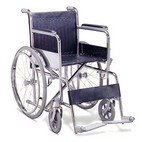
Monday, 2 February 2009

Wheelchair Frustrations Part 2

Wheelchair Frustrations!
(No Manuals Supplied For Wheelchairs!)

Your toaster continuously turns white bread into charcoal briquettes so you go down to your local department store and buy a new one. On returning home you open the box and out falls a 'User's Manual'. Shampoo Bottles come with the explicit instructions "Apply, Rinse, Repeat" for those unfamiliar with the concept of shampooing. The toaster is sure to come with a manual telling the purchaser the features, how to use the item, safety issues, trouble shooting, and exploded diagram of parts & components as well a list of the toll free numbers to service centers who are authorized to repair the unit should it need it. All this and probably in two or three languages as well.

What do you get when you buy a $18,000 motorized wheelchair, or a $6300 manual chair??? Nada, nothing, zilch....
Of course they want you to buy the service contract, no doubt at inflated prices because it's a "health related" item.

Now if something breaks, I have to get on the phone and tell.....tell whom????...tell someone that "the do-hickey fell off of the thing-a-ma-jig so that the wigit now hangs off the big black thing."

It just seems to me that such expensive items, with parts that may need replacement, should have some information included with the product so that a capable owner is familiar with their chair, can look after it properly and safely and can intelligently inform a service department of problems they may be encountering.

Is a paper manual too much to ask?

Saturday, 10 January 2009

Wheelchair Distributor & Private Insurance Frustrations!

Wheelchair Distributor & Private Insurance Frustrations!

August 29th, 2008: Okay, so after one full year of waiting, I finally have the proper basic manual wheelchair in a configuration that I belive will work for me. Just in time for the September Labour Day long weekend starting on September 4th. Within days of having the wheelchair finally in a usable form allowing me to "trial" it further in the real world, the invoice arrives in the mail. $6300.00 due on receipt.

Well, I would really like to try it out now that I have the proper chair with proper seat and proper back etc. - that's what the "trial" should be! I can't very well evaluate it when I've been given the wrong chair or have the wrong back etc.

The invoice dated early August was postmarked August 29th and received in the first days of September. Within days I get the phone call from the chair distributor asking if they can send a driver over to pick up the payment. No!! Perhaps others have a spare $6300 laying around but I don't, particularly after having spent any savings on medical necessities not covered by government agencies or private insurance.

Look, let me submit the invoice to my private insurance carrier to see what they cover. When I receive the cheque, I'll send it along to you as well as any balance owing.

Previously by phone, I was informed by my private insurer that "the chair would be covered up to 100% for the customary ammount allowed in our area". Huh? They may fund 100% of whatever they decide upon? $3000 was given as the upper limit.

First Submission Of Claim:
Early October - So I send in the invoice and wait,...and wait... After some three weeks I get notification that they decline to fund. They need to know what portion ADP (Assistive Devices Program) has funded. Silly me, as no place on the submission form did they ask for that information when I submitted it in the first place. As I was submitting the total cost it should be self evident that ADP was not assisting in financing. Delay tactic number one.

I write a letter indicating that ADP is not funding any portion of the cost. The entire cost is mine.

Second Submission Of Claim:
Early November - Off it goes until another three weeks later I get another notification that they once again decline to reimburse me for any portion of the wheelchair. Why? Because I have to PAY IN FULL and send them proof of such before they will consider reimbursing me. Couldn't they have told me this on the phone during my initial call or in the notice of the first refusal?? I may be cynical but I believe they are playing games with me hoping I'll get frustrated and drop my claim. Delay tactic number two.

During this time I've been getting repeated terse phone calls from the supplier's Accounts Payable department demanding payment. Bordering on threatening. Very uncomfortable calls! I try to calmly explain that I'm waiting to hear back from my insurance company. I waited a year for the chair, can they not wait a few weeks for payment???

Early December - Well, It's coming up to Christmas by this time and with savings depleted and creditors breathing down my neck for payment, it looks like it will be a very bleak Chrismas season. I still don't have anywhere near the full amount they demand.

I get a phone call from the sales rep who was in charge of putting the chair together. I tell him of my frustrations and suggest if they can't wait for me to work the financial situation out that they should come and take the chair back.

TAKE THE CHAIR BACK???

He proceeds to tell me that I've had the chair far to long and that the company will refuse to take it back!!
Well, I've had the chair too long because it took you a year to get it put together in a useable form for me!!
What really bugged me was that while the sales rep was speaking to me over the phone, he kept muching away on an apple or some food item. The sounds of him stopping to chew, pause, think express his dismay, pause and chew again grates on me even more long after the call ended.
At least give me the respect of offering your full attention.

I have to wonder at what point the wheelchair went from being a "trial" item to being my, yet to be paid for, possession? On which date did I cross the line?

So, in the end, I begged, borrowed, but being in a wheelchair, couldn't steal - managing to scrape together $6300.00 from friends and family. The bill was paid in full, the invoice stamped "Paid in Full" was submitted to the insurance company for the third time and after about another three weeks received a cheque for $3000.00.
I do feel bad that I may have depleted some of the monies which were slated to be paid to the insurance company's CEOs as bonuses on top of their million dollar salaries. Wouldn't want to yank bread out of their children's mouths....

The Sales Rep I had dealt with over the months never called back with a thank you but then again I guess that would be too much to expect.

Long after having received my "Paid In Full" stamped invoice from the accounting department, they called once again asking this time in a civil tone if I had had any luck with my insurance company and when they could expect payment. I had paid in full weeks ago.
What competence!

I guess that all health care supply firms feel anyone in my position has a HUGE insurance settlement and can afford to pay outrageous prices while the private health insurance carriers believe everyone with that same insurance settlement doesn't need private health insurance reimbursement. Not everyone has a settlement of any sort.

What exactly is insurance, of any kind, for?? You pay monies into a fund which you hope to never have to use but if you do you know that major expenses will be covered and reimbursed should some major unforeseen calamity happen. It is to cover those major unforeseen expenses which otherwise you would never be able to afford. If your house burns down, your insurance will pay to rebuild it and restore it's contents. We have insurance because the home owner alone would not be able to come up with this amount of money on the spot after such a major disaster. Would the insurance company insist on the home owner rebuilding the home out of his own pocket and then submit a claim and wait for approval and reimbursement?? No, the insurance adjuster makes an assessment of the damages and issues payment so that rebuilding can commence. How then is it that after a catastrophic illness and all it's unplanned out of pocket expenses, does an insurance company require me to pay in full for the item in question and then they'll reimburse some part of it? No wonder why insurance companies are loved about as much as lawyers and politicians.

The whole reason I had extended health care insurance was that if I ever needed a wheelchair, or other major health care item, that it would covered, in whole or major part, so that I could afford this necessity and it wouldn't further stress my financial situation. Dream on!

I don't expect sympathy for my situation but a little bit of understanding and even some compassion would be welcomed. I found none...

Wednesday, 17 September 2008

Personal Parallel Bars

Personal Parallel Bars

With the arrival of September I found that I could stand unsupported. Prior to this I could only stand when my legs were 'blocked' or when in the KAFO (Knee Ankle Foot Orthotic) which held my knees rigid. If unsupported my knees could hyper-extend with great pain. Now I found that I could park my wheelchair in front of the kitchen sink, plant my feet on the floor between the chair and the sink cabinet and haul myself up to a standing position. There I'd wobble but stand free of the chair and the cabinet. Fighting to stay upright, the muscles slowly began to respond and tighten. Over a period of a couple months I became steadier. Realizing I could stand unsupported I tried walking at the parallel bars with the single AFO that I had and found I could do so. The second AFO was ordered at that time. Because I could walk at the parallel bars, I asked a friend of mine if he might find some way of building some parallel bars for me. I drew up some plans and e-mailed them off.

Unbelieveable! A short time later he arrives at my home with custom made parallel bars welded together, painted and attached to a carpeted floorboard. A number of friends and aquaintances contributed to the project and I can't thank them enough. Try as I might, they wouldn't accept payment for them.

So, now that I have parallel bars in my dining room, I can stretch out and practice walking on the days I don't have physiotherapy at the hospital. These have been a great help in my rehabilitation. Thanks so much Steve, and the others involved!!

Friday, 29 August 2008

Manual Wheelchair Frustrations

My #%$@* Frustrations
In Dealing With A Health Care Company


While in hospital an electric wheelchair was chosen for me by the facility. The chair served me well and continues to do so but with my increasing mobility I had a desire to get out into society on my own schedule and not have to rely on handicapped transit . Handicapped transit has also served me well but trips have to be booked 24 hours in advance and the small pickup time window must be strictly adhered to. As I am now able to stand, step and transfer, family and health care professionals suggested I look into getting a manual chair to complement the electric one. With the manual chair I could transfer to our private car and come and go as I please for outings which would be both physically and mentally rewarding.

As ADP (Assisted Devices Program) helped defray the full cost of my electric chair, I was not entitled to funding for the manual chair.
It is my understanding that a second chair (backup) is a luxury.
The total cost of this chair was my responsibility.

With the assistance of my Occupational Therapist, a suitable chair was chosen and an order was placed with a major health care franchise. The Occupational Therapist pre-warned me that each health care company offers its own difficulties when dealing with them.
I was about to find out how true this was.


On August 29th of 2007 an order was placed with the company and I was informed the delivery time would be about 2 weeks. The wheelchair would be “on trial" for me to determine if the arrangement of components suited my needs.

Below is the timetable that I ended up being subjected to.
See if you, the reader, feel this time frame and business practice is acceptable.

As a quick summary, the promised 2 weeks turned into 4 months at which time the wrong chair with the wrong seat by the wrong manufacturer was delivered. It took almost another 7 months to get the proper seating requested from day one, and to get the proper backrest. Within days, I received a phone call from the company suggesting they could send a driver around to pick up my cheque (payment in full). Now that’s $6300 for two bicycle tires, a seat, some metal tubes and plastic footrests. Wow! I really didn’t expect that price. Each item must be individually inspected and blessed by the Minister of Health.

August 29th, 2007
-Wheelchair Ordered
-Requested Quickie 2 (Order says EZ Ride)
-2 weeks delivery time stated (later changed to November 5th due to “special order” size/weight issues.
-requested simple cloth/cushion back (cheap) as not primary chair
-car transport and backup only. Discouraged - talked into rigid back
-J2 Deep Seat Cushion Ordered.

January 25th, 2008
-Wheelchair delivered. (Wrong Wheelchair delivered - Maple Leaf Brand)
-Correct chair Quickie 2 however is on the delivery form.
-Not a Quickie 2 Wheelchair but rather a Maple Leaf Brand!!
-Wrong Seat Cushion delivered. (correct make on invoice)

February 19th, 2008
-Correct Wheelchair delivered (Quickie 2)
-Wrong seat cushion once again delivered (correct make on invoice)
-No instruction/parts/user manual comes with chair.

April 9th, 2008
-New seat cushion delivered
-second delivery of wrong make and model of seat cushion. (correct make on invoice).
-Rigid back not comfortable - requested J2 Plus cushion on advice from OT.
-one wheelchair tire not holding pressure . Technician delivering back has no idea what correct pressure should be.

April 11th, 2008
-Seat cushion delivered - third delivery of wrong make and model of seat cushion. (correct make on invoice)
-Change back support to J2 Plus
-Plastic stiffener added to prevent cushion from “folding or drooping’ when seated.
-Wheelchair tire still won’t hold pressure.
-Technician takes chair with him to add back support brackets. Brings back chair with leaky tire inflated but unsure of pressure.

April 14th, 2008
-Correct seat cushion finally delivered on 4th attempt.

June 25th, 2008
-Matrix Elite Back delivered
-Tire continues to leak pressure

August 29th, 2008
Bill-invoice arrives for chair (Dated August 2nd)

September 4th, 2008
Supplier's Accounts Department calls asking if they can send a driver over to pick up the full payment. (like I have $6300 at home or have managed to submit, have approved and been reimbursed that amount from my insurance provider.)

One Year almost to the day to receive my basic manual wheelchair after initially being informed that it would take 2 weeks to assemble!!! Is this competence??


Now in this day and age of e-mails, faxes, phones, couriers and overnight shipping, why does it take months to get any particular part? Do they have to write a letter, sent by boat to China to have some child labourer hammer out a wheel when any particular order is submitted?

Read about my insurance woes in the next post.


Monday, 25 August 2008

Frustrations

Frustrations!!!
With reduced physiotherapy hours due to summer vacations a pregnancy leaves you'd think there would less problems encountered.

Walking with the leg braces last week I managed 6 repetitions of the hospital hallway on Tuesday. The longest length I've covered to date at one time. There were no ill effects from the walk.
Wednesday I walked 3 lengths and notice after two that something is not quite right. Arrive home to find both feet bloody with massive blisters on both arches. What's the difference???
With 5 days rest the right foot is still weeps fluid. No walking this week.

Friday, 15 August 2008

Dealing With Bureaucracy

Dealing With Bureaucracy
(Government Woes, Amongst Others)

When I first arrived back home from the hospital, my head was still reeling from coming to terms with this life altering injury. I arrived home to a mass of paperwork which had been demanded to be filled out and returned. Hardly able to comprehend what was before me, I dutifully filled out the forms & applications and sent them off. Now they were coming back to haunt me.

My intention was always to recover best I could and return to work. As such I had no intention of collecting my meagre pension at this time if I could avoid it. Nevertheless, I sent in the requested forms to my Private Pension Plan and to the Government of Canada Pension Plan with a cover letter explaining my intentions.

No I find out that my Private Insurance Carrier who pays my Long Term Disability (LTD) had at some time previous, reduced my LTD with the assumption that I am collecting monies from my pension plans. Why do they automatically assume that?? To avoid paying out I imagine.

So, to recover the amount of LTD they are withholding, I would have to contact each of these pension plans and obtain letters from them stating that I am not, nor have I ever (post injury) received any money from them.

Now I send off letters to each requesting from them letters confirming I have not received pay-outs.

My Private Pension Plan:
  • My Private Pension Plan sends me back a form letter acknowledging I have applied and stating that I am currently receiving free accrual of pension monies. No mention that I am not collecting income from them.
  • I write back again explaining in detail what I need from their office and once again get the same form letter.
  • A phone call clarifies the situation and I finally do get a letter stating that I am not collecting pension money from my private plan.
The Government Pension Office:
  • First letter goes unanswered
  • Second letter goes unanswered (is the phone the only acceptable form of communication these days? - they do supply a mailing address)
  • phone their offices and play the dreaded "your call is very important to us" phone tag game. Get disconnected and start again. Finally get through to a 'slow talker'. I ask him if he would send me such a letter? No! I ask him if his records show that I am or have collected money from the Canada Pension Plan. He answers "No". Then can he send me a letter stating that fact? He answers "No". "Why", I ask. "Because BY LAW we are not allowed to do that." "By law you are not allowed to write a letter to the fact that I am not collecting Pension Money?" from the government "That's right" -MORON!
My government at work on my behalf. Do they take courses on how to be difficult??
In the end he referred my request to a supervisor who did send a letter stating that my application is being processed. I hoped that "Being Processed" would be taken as not yet completed therefore not receiving benefits. In the end my Private Insurance Carrier accepted these letters and reinstated my full LTD benefits and sent me a cheque for the amount withheld. What a run around!!

The government stated on their forms that it could take up to 8 weeks to get a ruling on eligibility on receiving the Canada Pension. I finally got a phone call 4 months after applying and discussed with the representative my situation. I formally declined the pension as my intent was to return to work. My file would remain open for three months after which it would be closed and I'd have to re-apply.

Incompetence and paper pushing bureaucracy must have become an art form - or perhaps it's me who's a moron!

In addition:
My doctor charges $120 for filling out each of the forms - 2 Pension Plans and one Return to Work form. He gives me receipts to submit to my insurance company so that he can be reimbursed. I send them off to my private carrier and they only honour the 'return to work' form as it was at their request. Not sure where to send the others. Nobody acknowledges that they cover such an expense. So I guess the remaining two are out of my pocket. $240 to fill out applications for services I never wanted. Luckily my doctor was generous and forgave the other two.

Monday, 11 August 2008

Progress?... Really?

Progress??....Really???

Everyone has been telling me that I'm making progress. Physo patients who I don't know have even stopped to chat and told me how they've seen me improve. Then why don't I feel it???
Things will never be the same but I don't see any 'light at the end of the tunnel' where I feel that some degree of normalcy and joy of living returns. Eighteen months ago I was catheterized and hauled in and out of my chair with a hoist and now I move about from bed to chair to washroom under my own power.

So why was I more optimistic about the future when I first started the journey to recovery than now?

Constant pain varying from moderate to intense is continuous - relief comes only when passing out asleep.
  1. Nerve Pain continues - from just below the knees to the toes. A pain which is a cross between intense burning or an intense tingling (needles & pins). No relief from any medication (Nortriptyline & Gabapentin). So intense at time than it is difficult to concentrate on any task as my mind is constantly being drawn back to the pain.
  2. Sciatic Nerve Pain - Muscle imbalance has left one side of my abdominal/pelvic/back muscles weaker than the other side causing one side (hip) to be pulled out of alignment resulting in intense sciatic nerve pain. Doctor could offer nothing for relief & a year of physiotherapy has not helped this condition.
Have to wonder how long before I'm driven mad by the pain???

Spasms: an involuntary rhythmic contraction and release of the muscles, particularly the legs but extends into the back. Spasms have lessened in severity & duration over time but still can start up on either leg and be extremely annoying. Muscle contraction can be mild to extremely violent. A condition I shall have to live with.

Mobility: Continue to improve. It seems to me that 50% of my mobility problem was a direct cause of the spinal cord abscess and the other 50% was caused by muscle/ligament etc. deterioration from a half year+ lying in bed. Even now, some two years later, the amount of walking I can do is for the most part dictated by the time I spend in the physiotherapy department. After warm up and putting the braces on, there is only about a half hour of actual walking time available. A half hour once or twice a week is insufficient for recovery!!!

In the last few months walking has become more fluid and I'm able to stand more upright although the tight muscles/ligaments in the lower back refuse to loosen up and can cause a rather intense dull pain after standing erect for some time. The muscle weakness that is causing my sciatic nerve hip pain also shows up as I sway and collapse more to my left side with each step I take. I am starting to take the large and bulky leg braces home with me to add some additional time walking, however, neither our home's interior nor backyard etc. offer much room for a proper effort.

I have had one AFO (Ankle Foot Orthotic) made which I'm starting to use as my knee gets stronger and no longer buckles or hyper-extends as I put weight on it unsupported. It's my hope that in the somewhat near future I can get an AFO for the other leg and that I'll be able to replace my bulky KAFO (Knee Ankle Foot Orthotic) with the AFOs and have a more normal walking gait.

I am riddled with frustrations and overwhelmed with anxiety. Have to get back to work in order to continue my extended health care benefits including the drug plan and physiotherapy, yet the constant pain and discomfort make it difficult to concentrate.


Walking the Hospital hallway with KAFO (Knee Ankle Foot Orthotic) Braces and Walker
(3-5 repetitions of hallway length 2-3 times per week)

* * *

Saturday, 2 August 2008

Citizens Too Self Important To Care

While some drivers may honestly not see handicapped zones and inadvertently park in one, from my observations, most are too rushed, self important people who just don't care. Sad!


Friday, 16 May 2008

Perpetual Pain & Discomfort - The New Normal.

Perpetual Pain & Discomfort - The New Normal.

With the easing of trauma around the spinal cord resulted in increased recovery of movement but along with it, the increased pain and discomfort of the neurological damage. On the up side, signals to the muscles were beginning to get through but on the down side nerve pain increased what seemed proportionately. Now, although a good deal of mobility has been recovered, I live most days in excruciating discomfort and pain. The available drugs do little or nothing to ease this distracting discomfort.

Can’t Stand & Can’t Sit

Sciatic Nerve Pain:
Although I can stand up at the parallel bars or when braced against my chair, and can even walk with my leg braces, neither can be done for any length of time. Whether through physical trauma or the consequences of infection, injury to the spinal cord is usually asymmetrical. In my case this resulted in a muscle imbalance affecting the ‘pelvic cage’. My left hip doesn’t sit in the proper position resulting in what I would assume is pressure on the sciatic nerve. With the muscles not holding the hip joint in the proper position, the joint often produces a ‘hitch’ with a audible click as a ligament catches producing a moment of pain in the hip joint. This is in addition the sciatic nerve pain which simply feels like pressure pain on the hip joint when sitting in a chair or even semi-upright in bed. Even lying on my side or on my stomach doesn't stop the pain. Often it continues to throb with every beat of my pulse. The sciatic nerve causes not only hip pain but it radiates right down to the heel of the foot. Exercises may possibly help as well as non-steroidal anti-inflammatory drugs (NAIDS) - neither of which offer me any relief.


Damaged Nerve Pain:
Nerve pain, whether caused by progressive diseases such as diabetes, cancer, guillain-barré syndrome or by physical trauma can result in a burning discomfort in the affected limbs, in my case the legs. My legs feel as if they are immersed in very hot water which can extend as far up as to the knees.

Shooting Electrical Pain: On occasion I get these shooting electrical pains which feel almost identical to having had that limb touch a live 120V electrical wire. A sudden and unexpected shock or zap causes the limb to jerk in response. These electrical shooting pains usually occur in clusters - after a number of zaps the subside until the next event.

Other Physical Pain: Walking with the leg braces has resulted in further damage and discomfort. The rigid braces pushed against soft flesh resulted in pinching and gouging in more delicate areas, particularly the inner thigh resulting in bruising, blistering, bleeding and abrasions. Having been bed ridden for so long, the soles of the feet have lost there normal toughness and calluses. The smallest amount of rubbing results in blisters and bleeding. This has to be watched carefully with the impaired sensation I have.
Because of the muscle imbalance from the injury, the sciatic nerve is irritated on my left but on my right the right hip does not activate properly when attempting to walk in the braces. The hip seems to lag behind and does not want to come over the leg/knee when taking a step. The resulting swagger in my gait is caused by that hip momentarily falling out to the right side. As it does the right leg twists in compensation resulting in an irritation and slight pain in my left knee cap as it twists. Ultrasound therapy may be in order for the knee if the pain persists.

Muscular Spasms: A direct result of the spinal injury. Although not a pain as such, the are a tremendous nuisance. Again, often unexpected or preceded by what might feel like a momentary increase in tension, the leg will jerk uncontrollably and usually set up a rhythm. The limb might jerk as often as once every few seconds. This could last for minutes or hours. The spasm or jerk could be so unexpected and violent that one is unprepared for the action and the intensity might not even be duplicated if one tries. In other words, I would not be able to move my leg that fast if I tried. I cannot voluntarily duplicate the suddenness and intensity of the jerk.

With the increased mobility has come distracting, annoying and frequently excruciating pain. I can't find comfort nor sitting or in standing. Constant pain is so distracting that it is often impossible to concentrate or focus on a task whether reading a book or just watching TV. Passing out in sleep seems to offer the only relief.
(Is this any way to live?)
* * *

Monday, 28 April 2008

Recent Changes/Observations

Recent Changes & Observations on Nerve Pain & Movement

Nerve Pain:
As mentioned previously, my first recovered movement was observed in my legs some 5 months post surgery. The next noticeable change occurred in January of 2007 when reaching for an item I noticed movement in my trunk. I suspect that the inflammation from the initial injury and surgical trauma began to subside in earnest at this time as concurrent with this improvement came improved transmission of all nerve signals. That included nerve pain which began as a burning sensation in my legs. This particular nerve pain could vary day to day in both location and intensity. The nerve pain has been with me daily since that time, 1 year and 3 months now since it first appeared.
  • Location - nerve pain could be as low as the ankles to the toes or extend from the toes to the knees.
  • Intensity - nerve pain can feel as gentle as having limbs immersed in soda water - a gentle bulbing, or it can be excruciating painful as if my legs were immersed in boiling water. The later occurs more often. In addition, on occasion, the legs get a feeling I can only describe as "creepy' - the feel intensely uncomfortable with an intense unpleasant tingling sensation that gives me the mental impression that the legs have swollen or blown up in size - under pressure - which they have not. There is no visual change, only the mental sensation. The drug Gabapentin does little or nothing to ease that particular pain. NSAID (Non Steroidal Anti-Inflammatory Drugs) have no effect on that pain either.

I have found no correlation between activity, exercise, height of legs (sitting/lying etc), diet etc. in the amount of discomfort I feel. Intensity and height (location) vary daily and for no apparent reason.
One observation that does seem to hold is that the burning or pressure feeling comes on more at night. My physiotherapist stated that this seems to hold for others with similar injuries although she didn't know why.

Changes? - Recently, during pool therapy, I have tried standing with my toes on a step in the pool and my heels hanging over the edge of the step. This aids in stretching out the achillies tendons which have shortened due to the inactivity. On two occasions I found that the following day the nerve pain was greatly reduced - to a livable intensity. I have to try repeating this to see if it in fact does reduce the nerve pain.

Mobility - Now, almost two years post injury I've noticed movement in my feet (below the ankles). I suspect this is more of a result of exercise than any change of neurological condition. The more I've been standing and walking with the leg braces, the more the achillies get stretched out and foot joints loosened. Now I can wiggle my feet up and down although pushing down the 'ball' of my foot is more effective than pulling it up. I also notice the tiniest flicker of side to side motion of the foot. ie. if the foot is flat on the floor, being able to push down on the inside or outside edges alternatively. Both these actions are crucial in maintaining balance while standing.

Monday, 31 March 2008

Spinal Cord Injury Recovery - Update

Recovery From Spinal Cord Injury
(A Mixed Blessing???)
(Living with Nerve Pain)

Summery: Movement improvement ~90% but with greatly increased nerve pain but lessening spasms. (some of this post is redundant from previous posts)

When in October of 2006, some 4 months post surgery, I started to notice the first signs of movement in my legs, I never realized what a painful and emotional experience the recovery process would be. In the end of January of 2007 the next real physical change occurred when I noticed some strength and movement in my trunk. I feel that at this point in time the inflammation began to recede which then allowed more signals to travel up and down my damaged spinal cord. This was a mixed blessing. The steadily increasing strength and mobility was of course welcomed but the flip side of the recovery coin was that sensation/pain signals also began to flow producing discomfort to the point of being unbearable on many days.

I can now move but live in continuous pain and discomfort. Will the discomfort ever ease or am I destined to go crazy from the never ending intense pain?

Medication to control pain is either ineffective or if it has some effect, perhaps if I were to go off of it I would truly be in excruciating and unbearable pain.

During my time in the hospital and rehab, I had no pain associated with my injury. Regardless, I was placed on the nerve pain medication Gabapentin. It was only 3 months after discharge that I began to feel a tingling sensation in my legs. That tingling sensation soon developed into a burning sensation which could vary day to day. My sensation is best described as varying from what would, on better days, feel as a tingle or having my legs immersed in club soda water. On bad days they burn intensely as if my legs were immersed in boiling water. The sensation/pain could be from the ankles and below or more likely extend to the knee caps. The later is more likely. I haven't been able to make any associations or conclusions regarding this nerve pain. There seems to be no correlation between intensity and exercise, weather, diet, fatigue, position, room temperature etc. The only correlation that seems to occur is the the burning increases at night.

Nerve pain differs from conventional pain which we all have experienced. This truly is a searing, burning pain which may tingle. At it's worst, it is so distracting that it is difficult to concentrate on anything other than the pain making it all but impossible to even watch TV without constantly being distracted.
Nerve pain also differs from conventional pain as conventional analgesics (pain relievers) such as acetylsalicylic acid (Aspirin), ibuprofen (Advil), acetaminophen (Tylenol) etc have no effect. To my knowledge there are only some 4 drugs in general use which may be effective against nerve pain. They are:
  • Gabapentin
  • Nortriptilene
  • Amitryptiline
  • Pregablin (Lyrica)
I am currently on Gabapentin & Nortriptyline yet the pain can border on unbearable at the worst of times and distracting at the best.

My doctor wrote a script to add Amitryptiline to my other nerve pain medications but the pharmacy informed me of what I suspected. Amitryptiline and Nortryptiline are closely related analogues of each other with similar actions and it wouldn't be rational to prescribe both concurrently. My pharmacist was going to discuss this issue with my doctor and get back to me by phone before filling the prescription. No phone call came and I didn't pursue the matter.

So now that I've regained much of the mobility I had hoped for, on most days I live in continuous excruciating pain. In all the reading I have done, there seems to be no remedy for this condition.

A Summery of Spinal Cord Injury Recovery
(From Injury to March 2008)

March 2008 -
Having been paralyzed from the chest down (T-5) I have recovered motion, almost to the point of being normal in action and strength right down to my ankles. I am able to flex my foot up and down at the ankles but not side to side at the ankles. Lower abdominal muscles are active but very weak which I believe can be strengthened and recovered with proper sustained exercises over time. Tactile (touch) & temperature sensations extend right to the toes but are lessened and altered the further down I go. Below the ankles I can sense temperature changes but it takes a second or two to register and touch/pressure does not feel normal but rather like a tingling sensation.
Spasms which previously plagued me for hours on end have diminished and now occur sporadically, usually for short periods of time, more often at night and are not usually as intense as they once were. They still are present and like the nerve pain, I cannot link them to any trigger such as exercise etc.
I am currently walking with braces and a walker for about 120 meters (360 feet) at one time, up to three times a week. Although wobbly, I can stand without braces at my kitchen sink and put away dishes in the upper cabinets.

Tightness - Muscles, tendons and ligaments that have been active and at a certain length in daily functionality over my lifetime have shortened and contracted during post injury bed confinement. In spite of trunk & chest muscles becoming active, even after one year I feel as if I have a large elastic band wrapped around my core. I can breath normally but if I cough it feels as if my diaphragm doesn't give and there is pain with each cough. On standing, my legs have to stretch out as the muscles want to contract and not stay at their functional length. I can feel individual muscle bundles or sheaths in my calves slide against each other when standing. They stretch out over a day of exercising but once again contract overnight. A very unsettling feeling. How long before the muscles remain at a functional length??
Adhesions - When twisting, stretching or moving, particularly with the chest and trunk I often get the sensation of tearing flesh. I believe adhesions that have formed over the year where I was unable to move. In my mind, adhesions occur when muscles or layers of tissues which normally slide past each other now have formed bonds or bridges between layers. They no longer slide but tug, tear or ratchet past each other. Layers of tissue do not want to separate and when stretched, the bonds tear. This gives a momentary painful tearing sensation but doesn't last. Hopefully over time the tears become less frequent, the bonds are broken and the movement of tissue layers slide smoothly across each other. I have had massage therapy in hopes of speeding this process but am unconvinced that it actually helps and my private insurance offers limited funds for massage therapy. Funds have been all but used up in about 5 sessions. I see no point in continuing at this point and intense contortions and stretching are probably as effective.


January 2008- Started to "walk" with the braces for the first time in about late January. Firstly up and down the parallel bars and then in late February walking in the hospital hallway with a walker and the close supervision of my physiotherapist.
The design of the leg braces could have used some improvement as the locking knee hinge mechanism doesn't work smoothly, the lever comes apart and during the walking process, the left and right leg hinge mechanisms can latch onto one another and lock preventing me from taking another step. I have to teeter around on the braces and walker trying to unhitch one leg from the other which may lead to my physiotherapist having a heart attack! I came up with my own modification which I'm still evaluating but it seems to have reduced if not eliminated the locking problem.

From January to March I progressed from having to have two physios haul me up out of my wheelchair to the parallel bars and assist me in moving one foot out and back, to my walking virtually unassisted for 120m down a hallway. Proprioception remains a problem as I cannot tell where my feet are without looking at them. This propagates bad posture as my butt sticks out as I look down changing my center of gravity. Still working at that.
Being in bed or chair-bound for so long, I find it difficult to push my hips forward over my leg and recover the proper center of gravity necessary for walking. I can push my butt and hips forward to where they should be but find it difficult to hold them there. Hoping this will loosen up over time as it took time for them to seize up.

September 2007- First fitted for the braces and continued to strengthen with bench exercises and with the 'Sit-To-Stand' or 'Standing Frame' apparatus in order to recover balance and strengthen leg muscles.
Up to September of 2007 I could transfer myself from my wheelchair to my bed unassisted and lie down but not much else. With great effort I found that I could flip over on my stomach by bridging with my feet and back and scooting my butt sideways to the edge of the bed. At first I would haul myself over on my side, then stomach using a rope tied to the bed frame as my bed doesn't have any side rails. Running shoes or 'water socks' (slip on canvas shoes with a tacky rubber bottom often used in water sports) provide grip and make turning easier. At first I would sleep with the shoes on in order to flip at night. I soon found that this was no longer necessary and that I could push off with the heel of one foot and roll over around my other extended leg. I attribute the absence of skin related problems to my ability move around in bed. Pressure sores and infections have never been a problem with me.
I now flip around in bed back to stomach, side to side, end to end and sit up with relative ease.
Spasms seemed to lessen at the end of August of 2007.

January 2007 - became aware of trunk muscles recovering. Could lean forward and sit up rather than falling over like a rag doll. Started physiotherapy 4 times a week at local hospital. With the increasing motion a rather intense nerve pain in the legs developed. Spasms continued - quite severe at times.

April 2006 to December of 2006 - When I awoke one morning and realized I couldn't move my legs, I had no pain or discomfort whatsoever. Pain was first felt as the result of major surgery which was treated morphine but resulted in intense and disturbing hallucinations. While in initial recovery I noticed that occasionally my right leg would occasionally jump. This curiosity was to be my first experience with paralytic spasms. At the Rehab hospital spasms increased tremendously even after being placed on the maximum dosage of the anti-spasmodic drug Baclafin. Valium was added in order to assist the Baclafin action but it just made me a drowsy 'spaz'. Botulinum toxin was suggested as a therapy - full paralysis to ease the spasms. I declined.
On waking each morning I tried not to move as I discovered that soon after starting to move my upper body the spasms would start. At the Rehab hospital spasms would start in the morning and last all day long until I passed out at night. One leg or the other (funny, not both together) would start jerking, perhaps once every few seconds continue unabated all day. Spasms could be a mild annoying twitch to jerks so intense that the repeatedly lift/throw the leg up in the air and off of the chair or bed. I felt that if restrained, these violent spasms could tear tendons and dislocate joints. Morning to night - jerk, jerk, jerk, jerk.... how do you concentrate on your life when in a spasmodic state? Luckily these massive and continuous spasms have decreased in intensity and perhaps are attributed to vigorous exercise or restored neurological pathways(?).
At the Rehab hospital the physios tried to put me on a motorized bicycle in order to move my legs for exercise and circulation. It was quickly realized that my spasms wouldn't permit my use of the cycle as the bike would detect the spasm and shut down in order to prevent injury. My bike couldn't move my legs safely and I couldn't move my legs. Currently (Mar 08), I use the bike at the hospital daily and push the cycle to the upper limit of 120 rpm with half of the available resistance dialed in (6Nm). Think of it as going uphill. I usually manage to peddle the equivalent of 17 Km (10.5 mi) in a half hour period.

Spasms and Baclofen - In spite of being on the maximum dose of the anti-spasmodic Baclafin, I continued to have spasms and jerk continuously. (see above) Thinking it had no effect I gradually reduced the dosage to see what would happen. The spasmodic jerks didn't increase but what I found was that muscular tension increased and my legs would want to clamp together. It became very difficult to peddle the bike or put my pants on etc with the clamping action. I went back on the Baclafin.


Monday, 24 March 2008

$750.00 For A Foam Seat!! - If I'll Ever Get it!

$750.00 For a Foam and Gel Seat!!!

Stick the word "Medical" on anything at all and mark up the product 1000%.
If you need it, you'll pay. After all, sometimes private insurance will pay or if not some government agency (read taxpayers) will defray the costs. That makes it OK.

In September I ordered a manual chair (Quickie 2) with a combination foam and gel seat - a J2 Deep model. It was to arrive in 2 weeks. Months later I got the wrong chair, from the wrong manufacturer & outfitted with a rather thin J2 model. I kept the seat to use on my motorized chair which I would exchange with the proper seating cushion when the correct chair and cushion arrived. In February of the new year I received the proper chair but with no cushion even though the invoice clearly indicated a J2 Deep and my having pointed this out in person to the company representative! The chair was still unusable as the back did not allow me to sit far enough back to feel comfortable and because of that my center of gravity was too far forward resulting in the chair tipping forward whenever I reach for anything.

Now it is mid-March and after more than 6 months I still don't have a usable chair nor the proper cushion!! This is not some custom item that some worker in China has to design & manufacture. This is a standard, from the catalog, seating cushion of which there must be hundreds of thousands in use throughout North America! Here in the age of faxes and Fed-Ex, I'm waiting months for a standard cushion!! There must be one more in some warehouse!

The price of the missing cushion as indicated on my invoice is $750.00!!!! The difference between the J2 and the J2-Deep is just that - the depth of the foam base making it a bit thicker for a big guy like myself. And what do you get for that $750.00? A dense foam base which is just slightly softer than a sheet of plywood. On top of that layer is a softer foam front over which one's thighs hang and a plastic bag containing a thick gel which molds to and supports you're butt.

I have to wonder how many study groups, design specialists , CAD programmers, medical experts and material suppliers were commissioned to come up with these two slabs of foam and bag of jell0 withing a cloth sack? Have to justify that price somehow....

As for that gel seat? - it is so hard that it is almost impossible to sit on it for any length of time. The gel does conform to one's bottom but as I have plenty of movement the gel squishes to the edges leaving my butt sitting on the incredibly hard & solid foam board. The gel has to be kneaded and redistributed each time I leave the seat. Still the gel is insufficient for any comfort.
While at home, I have on several occasions replaced the $750.00 seat with a cushion from my living room couch, which in it's entirety cost less than the gel cushion. It also offers better support and comfort than the "medically correct' cushion. If I could get to a furniture re-finisher's upholstery shop, I'm certain I could find some spare or discarded cushion for a few dollars. I could sew it into a black cover so as to appear professional and it would probably suit my needs better than the gel seat I have or the one I have been waiting for for half a year!!!

As for the sear, I'm still waiting.....


$750.00 - For that price it must be blessed by the Surgeon-General or at least the Ministry of Health. That knowledge will make my butt feel better!

Thursday, 6 March 2008

Transhelp - Transportation Cancelation Without Notice

Transhelp (Region of Peel -Ontario)
Public Transportation for those Physically Challenged


These days there is very little about human nature that surprises me however I have to wonder how many people would feign a disability in order to get subsidized door to door transportation? A slight limp, an undetectable heart condition? - maybe… But would someone acquire an $18,000, 350 lb electric wheelchair in order to dupe the transportation service?

While some clients of the Region of Peel’s Transhelp bus service are required to provide physician’s notes or be assessed in person at the Transhelp headquarters, I was never asked for proof of my disability. When first requesting the service in early March of 2007, I mentioned that I was in a power wheelchair and immediately was provided service.

I was using the invaluable service since March of 2007 as transportation to and from my hospital’s physiotherapy department 4 times a week, each and every week. A standing schedule was set up for my rides each and every day at set times. All I was required to do was to call up their automated service each night to confirm my intention make that trip.

Imagine my surprise when late last evening I called to confirm and the computer generated voice told me that I have no rides scheduled. The Transhelp office is closed at that hour, I have no ride yet I have an physiotherapy appointment early next morning. Frustration!!!

Well, it turns out that a year ago I was placed on a one year assessment?/probation?/whatever? and last night my access to the service expired!!! Firstly, I was never informed that I was placed on a one year assessment, no mention that I would have to re-qualify/re-apply after one year and also Transhelp finds no problem with shutting me off without any warning or notice. Now, this morning it’s a scramble to cancel my physiotherapy session and then to follow the red tape to re-qualify for transportation to my two physiotherapy sessions tomorrow.
Don’t you just love bureaucracy?!

All that said, the Transhelp service has been invaluable to me in providing transportation health care providers. As with any group of people you meet, different personalities will become evident. And so it is with the Transhelp drivers I’ve encountered over the last year. Some are loud gregarious chatters while others are subdued and quiet. Regardless, I have found all to be professional, friendly and helpful in what often are difficult circumstances. Whether dealing with illegally parked cars blocking hospital entrances or dealing with clients who may have a variety of physical or mental disorders, I have seen them take verbal abuse, threatened with physical abuse and watched deal rush hour traffic, reckless drivers and inclement weather without losing there cool.
To them I offer them my thanks.

***
This morning the Transhelp transportation co-ordinator said that a letter informing of the one year probation was mailed out when I was signed on. She stated I would need a re-assessement to re-qualify for the Transhelp service which presented a 'Catch-22' situation. I need Transhelp to get to their assesment office, but I can't get Transhelp until re-assessed! However, the co-coordinator was pleasant and helpful and waived the re-assessment. I was placed on permanent service, having verbally accepted my being in a wheelchair.

Tuesday, 19 February 2008

What - No User's Manual for $18,000???

$18,000 For A Wheelchair and No User's Manual!

Gripes: What gives? You buy an $18,000 automobile and in the glove compartment you find a users manual and maintenance schedule. You buy a $20 toaster and you get a users manual in 2+ languages, instructions in proper use, safety warnings and a list of repair centers. You fork out $18,000 for a wheelchair and what do you get? Nada! No instruction manual, no parts list, no written warranty - Not even a scrap of paper! Nada!
The battery powering the motor - how long do I charge for? Some batteries last longer if they are almost fully drained of power before recharging. Is this one of them? Do I recharge nightly or only when empty? The fuse blew - what type, what amperage, where is it located? A part broke - Rather than phone up and tell the service department that I need a Part#10053a, I’m left telling them that the do-hickey fell off the thing-a-ma-jig and damaged the what-cha-ma-call-it - can I get another. Service department? Had to play phone tag searching for the appropriate phone number for service. Who do I call when I have trouble? What if I break down on the town? ….and just what does my warranty cover and when does it expire.

Just this company? No, ordered a manual wheelchair from another company and again, no manual - how do the leg supports come off? The brake levers poke up my ass when I transfer - oh, they come off for transferring?? How am I suppose to know??

Put in an order for a specific wheelchair model from a specific company and am told it will take 2 weeks to deliver. Two months later, no chair. When delivered it is the wrong chair model from the wrong manufacturer. Still have the wrong seat cushion even though the specific type of cushion is clearly written on the requisition. Do they care???

"Give me your money, then get lost!!!"

Critical medical equipment and they can’t throw in an owner’s manual. I guess if they have to be called out for a service call, they can justify in charging $$ for the service call. That is, once they deliver the correct model with correct accessories.

* * *

Monday, 18 February 2008

Bodily Function Unpleasantries

Dealing With Bodily Function Unpleasantries

It had never occurred to me that when one has a spinal cord injury, muscles controlling bodily functions may be affected. Soon after being hospitalized I had an indwelling catheter inserted which, although changed periodically, basically remained with me for several months. Late in my stay at the rehab hospital a nurse enthusiastically informed me that I’d be going to “in & out” catheterization. Like somehow I’d be delighted in having to stick a plastic straw up my “wazoo” to allow urine to be drained out every few hours before it decided to release on it’s own. The prospect was not appealing to me at all! In a rush to get to an appointment one day, I was outfitted with an external condom catheter and leg bag. For whatever reason, I ended up using the external catheter on an ongoing basis, even after being discharged.

Prior to this injury I could hold urine like a camel holds water. Post injury, I found that I could hold for a reasonable length of time but when I felt that I HAD to go, I HAD to go!! The external catheter was preferable to manual insertions, which I felt could induce urinary tract infections (UTI) faster than the external catheter. In order to use the external condom catheter one needed to get a decent seal between skin and condom catheter. This required the use of a ‘skin prep’ which came as a small towelette in a pouch, much like the towelette wipes offered in restaurants after eating greasy finger foods. Trouble was that the fluid burned like hell each time it was applied. The seal did not always hold and a loose condom or detached hose certainly contributed to some embarrassing situations.

So much so that about a year post-injury, I became fed up and decided to go naturally whenever the need arose. At this point I could not yet stand effectively but around the house I would wear shorts, a pant leg of which could be hiked up to use a urinal bottle as the needed. Outside I might still have used the catheter/leg bag. Now, I can stand without difficulty allowing me to pull full length pants up and down so have stopped using the leg bag altogether, even when out in public. I still prefer to go in a container and then discard the urine rather than try to aim for the porcelain for hygienic reasons.

As for No.2, the bowel treatment concept was to have ‘treatment’ days to deal with evacuating the bowels at scheduled intervals. Stool softeners (Dulcolax) and a laxative (Senokot) were given the night before and the following morning you were given a suppository before being placed on a commode and being wheeled onto a toilet. There the suppository would trigger your bowels to evacuate and hopefully you were set for another couple of days without an accident. Disposable diapers were required for leakage.

You can imagine how unpalatable that treatment was.

Soon after discharge I decided to try to go naturally and found that I could. After discontinuing the artificial regime, my system returned to normal and now I just go when and as necessary.

I find I can clean myself up while on the commode and wheel myself in for a shower to completely clean up after each and every movement.

So, in summary, I “take a leak” naturally whenever I feel the urge, however I still cannot hold it too long and have to make for a washroom soon after the first sensations arrive. I do use a container rather than drive up to a toilet and try to aim directly as positioning may not be optimal and I don’t wish to irrigate my pants nor the public facilities. I “take a dump” naturally, without the aid of stimulants etc. whenever the need arises. I suspect I probably go less often than when I was ambulatory because of not being upright. Continuous walking, bending and moving probably helps the bowels move contents along.

On discharge from the rehab hospital, no mention was made of changes that I might expect or alternatives I might try to make these unpleasantries a bit easier. My methods of coping were developed on my own.

Wednesday, 6 February 2008

January 2008 Update - Walking With Braces

Update: January 2008 - Braces With Walker

Much of the summer months of 2007 were spent using the ‘sit-to-stand’ frame which, with the help of counterweights helped me stand. Leg muscles were strengthened by repeatedly sitting and standing for ever increasing periods of time. As muscles strengthened and balance improved, the counterweights were reduced until I was standing unassisted-hoisting my full weight under my own power.

September 2007: An orthotics specialist met with my physio and myself in order to fit me with leg braces. In spite of my being able to stand under my own power within the frame, muscles still did not work in unison and in the proper sequence . Ligaments did not hold the joints in proper position due to the year of inactivity. My legs could raise me but couldn’t hold me upright unassisted as my knee joints would hyperextend and I would begin to topple over. Braces were cast using a fast setting compound on a cloth like material wrapped around my legs. Once set, they were removed and used as a mould in which high density plastic would form a sleeve like brace extending from the sole of the foot almost to the crotch. Stainless steel locking hinges joined the upper thigh section to the calf section. Once in the standing position the hinges would lock and walking resembled “waddling” like a duck or like Frankenstein in the movies. The braces could be unlocked using a lever behind the knee. Once the knee joints strengthened and muscle “memory” returned to hold the leg in proper alignment, it is my understanding that the braces would be “cut down” to below the knee cap.

September 2007 to January 2008: There was some difficulty in just standing in the braces for any length of time as the braces held me in the proper upright posture. My Achilles tendon had shortened from non-use and as a result I was unable to stand flat. With my feet flat on the ground, I wouldn’t manage to stand perpendicular to the floor. I would lean backwards. I’m finding it difficult to stretch out the tendon so that the foot is flexible and that the feet don’t make me fall over backwards. The same year long activity has tightened my lower back muscles - causing them to resist my efforts to straighten upright and they ache when standing for any length of time. Over this time period I progressed from needing assistance in getting upright in the braces, to getting up with relative ease and walking the parallel bars back and forth repeatedly. The length of the parallel bars is about 10-12 feet and I would walk the length, turn and come back - repeating about 4 to 6 times before resting.

January 2008: Graduated from the parallel bars to the walker. The walker is an alluminum frame with Teflon sliders on the rear posts and wheels on the front posts. Because the walker isn’t attached to the floor as the parallel bars are, it was more difficult to stand up as the there was nothing ‘anchored’ from which to haul myself up. Once up I would walk up and down the hospital hallway about 100 meters at a time, and return - usually twice per session.

Walking with the braces and walker is now done three times a week within my hour session. A slow process - trying to undo a year’s inactivity an hour at a time, less than 3 hours per week. Fatigue sets in quickly and endurance has to be regained.

February 2008: My physiotherapist thought that massage therapy on my tight ham-strings, quads, calves and Achilles tendons would help in loosening them up. After an hour assessment session, a half hour weekly session was decided upon - for as long as the insurance coverage lasted.
I continue to walk weekly with the braces and walker, receive massage therapy on the lower limbs once a week and have a pool session once a week.

Friday, 4 January 2008

A Few Thoughts On Injury & Recovery

Just a few thoughts on Injury & Recovery

I did not need to hear “you’ll never walk again” - drawled out in a ‘ho-hum’ manner from not one, but two doctors on two occasions. A doctor will never admit to not knowing. If too full of oneself to admit to not knowing, then at least say “the odds are against it”. Science and medicine are advancing at dizzying rates and what is impossible today may be common place tomorrow. Regardless, don’t remove the last vestige of hope and the last incentive to try and fight the condition. Doctors should always stress the positive, offering hope and encouragement. The reality of individual situations will reveal itself along the road of recovery, however small or great.

I did not need to hear “you’ll be up and about in no time” - countless friends and acquaintances regaled me with stories of their ‘uncle’ who was paralyzed from the nose to the toes but has now recovered to qualify as a contestant on ‘Dancing With The Stars’. False hope is of no help either for I begin feeling that if I’m not progressing at a sufficiently quick rate, or I fail to recover, I’m letting those same friends down.

“We don’t know, the body is amazingly resilient in healing itself, great strides are being made in medicine - keep on fighting and see where you can get to” That I’ll accept with a “Thank You”.

I thank all my friends, family and acquaintances for their prayers for my recovery. I am truly appreciative of everyone’s prayers on my behalf. That said, I don’t believe my injury occurred because of God. It’s was not God’s action, it was a bacterial action in my case - an infection.
I also believe that any recovery will be due to whatever innate ability my body has to heal itself. It will be applied science, biology, chemistry, physiology, neurology, anatomy, histology & physiotherapy mixed with whatever determination I can muster.

As for God, I personally have no right to ask for God’s divine intervention to heal me, miraculously or otherwise. If God was to intervene, there are hospitals in cities and countries that are full of innocent children who are afflicted with terrible injuries and diseases with their distraught parents suffering at their bedsides. I just don’t see God helping me as long as these children suffer. Help them…. I’ll see how far I get on my own…

Monday, 8 October 2007

Time line - Summary of Change of Sensations No. 2

Update: September 2007
Time line - Summary of Change of Sensations No. 2;

Firstly a description of the last few months progress and observations then an update of the time line summary.

I am still amazed at the amount of muscle atrophy or at least ‘weakness’ that I had from my time being bed bound. During these months I continued to improve immensely with strength and leg mobility. The use of the Biodex, the Standing Frame (Sit to Stand Apparatus) and the pool has been immensely beneficial in regaining both. Nerve pain (burning) not is still constantly present in the feet but is usually at ankle level and below and of a low to moderate intensity. On occasion it can extend up to the knees and the intensity can increase to where it is a constant distraction. I haven’t been able to link the amount and extent of the burning to any outside factors such as exercise or diet etc. It seems it just happens.
The absolutely annoying leg spasms continued to plague me but not during all my waking hours as when in the rehab hospital. Spasms continued to come after intense exercise, usually in the evenings and one leg would start jerking uncontrollably, perhaps once every 3 to 5 seconds, either for an hour or up to perhaps 6 hours. At the worst, spasms can be so strong that if can feel as if the leg might pull itself out of joint Lying in bed I sometimes felt I could knee myself in the chest from these involuntary spasms. Very distracting and annoying!!!

As of about 10 -14 days ago, these strong spasms seem to have disappeared. (Knock on wood). I still periodically get smaller, milder spasms lasting a few minutes to an hour but I can live with those. The medication Baclafin use to combat spasms seemed ineffective during the last year and half as while I was on the highest possible oral dose, legs continued to “dance”. What I did find was that without the Baclafin, the actual jerking or spasms remained at about the same rate, however the drug combated muscle tension and the tendency for my legs to clamp together and the motion be more stiff.
Overall, I found that as I regained motion, I regained muscle tone and when this progressed, the muscular spasms lessened. My legs have regained all motion other than the muscles used to move the foot at the ankle and below. It was amazing to see how much trunk and abdominal tone I had lost. This resulted in severe back spasms which were at their worst first thing in the morning upon waking. I would almost be thrown into an arch with my back rising above the bed’s mattress. During the last month I found that I had the ability to turn onto my side and relieve the pressure on my butt. This was an immense relief!! The additional benefit from this rolling action was that it began to strengthen abdominal muscles and the oblique muscles further assisting the twisting and rolling action. It has been getting easier to turn on my side as a result. Lying on my side, I would attempt to raise my leg as in doing “half scissors”. This was almost impossible when I first attempted but now I can raise the straightened leg quite high and hold it. It still takes a bit of effort but it is getting stronger each week.
Bench work at physiotherapy has now been concentrating on these abdominal and trunk muscles as well. The pool has been instrumental in demonstrating the weaknesses in these muscles and helping to improve them.

Leg Braces:
In late August it was determined that I had progressed to where I could get leg braces and attempt to learn to walk again. At that time my physiotherapist had contacted an orthotics (1) specialist who measured and cast my legs for custom made braces. These braces hopefully be the first version in a progression that would help me to walk with some normality. These initial braces are huge and unwieldy which extend from the bottom of the foot and encase much of the leg right up to the hips and crotch. The braces lock at the knee once erect and have to be unlocked in order to sit again. The mechanism can be unlocked by an assistant or by the wearer by bumping backwards into a chair. The legs are made out of a plastic resin polymer. have a stainless steel knee hinge and are secured to the leg with Velcro straps. Because the knees lock to prevent me from falling over, I will have to walk like Frankenstein, rolling at the hips and swinging each leg forward in a wobbling like motion. We shall see how this works out. My hope is that the knees will strengthen to the point where the braces can be cut back down and my own knees will move and support me allowing a more normal motion. Standing at the parallel bars will begin next week.

(1) Orthotics - A specialist in bracing and support to assist support the motion of joints and muscles.

Update: September 2007
Timeline - Summary of Change of Sensations;

Late April of 2006 - discover that legs won’t move. Pain and discomfort was attributed to sprained back.

May 15th 2006 - Spinal operation and Laminectomy at T-5 to T-7 level to remove bacterial abscess. Remain paralyzed from lower chest downward. No pain, sensations or discomfort other than the realization of building spasms which peaked around September to October of 2006. These are more of a nuisance than a discomfort or pain.

Mid October 2006 - discover slight movement in legs. Can move knees in and out.

End of October 2006 - discharged for home. Slight movement remains secret.

November 2006 to January 2007 - some improvement in movement.

January 2007 - start to get burning pins & needles nerve pain in legs from knees down. Spasms reduce in frequency and some intensity. Hypersensitivity of nerves in hair follicles and altered sensation of pressure. Can feel temperature changes right down to my ankles.
Legs move freely and smoothly in and out, up and down and in circles when extended straight out. Joints bend at knees but not at ankles and cannot wiggle toes. Proprioreception is lost in the lower limbs. Some jerky motions or spasms in the limbs and back especially when lying in bed. Abdominal muscles regained activity and can sit upright with out much difficulty and without support. Rectal sphincter control has improved immensely allowing me to abandon a forced bowel routine.

End of May 2007 - motion continues to improve although more slowly. Spasms surprise me now and then and sometimes show up in the evenings after prolonged sitting or vigorous therapy. Burning pain or tingling remains and can move up or down the legs from feet to ankles or knees but is less severe than earlier. Perhaps some improvement in proprioreception.

May-October 2007 - Range and extent and strength of limb mobility has improved immensely over the last few months and within the last 20 - 14 days, intense leg spasms have all but disappeared. Minor spasms and jerks might still occur but are not nearly as severe or last as long as those previously. Nerve pain still is present, usually below the ankles but it too seems to be less intense and annoyingly distracting as previously. Abdominal and trunk muscle tone are being worked on. Next week I will begin trying to stand and walk with leg braces at the parallel bars.

Monday, 1 October 2007

Canadian Paraplegic Association's Welcome


My Welcome To The Canadian Paraplegic Association

I'm sure the Canadian Paraplegic Association (CPA) is a fine organization with a mandate to assist para & quadriplegics to assimilate back into the world. However I found my welcome rather uninspiring. Now I wasn't expecting a marching band, noise makers & confetti when I rolled through their narrow office door conveniently located upstairs in the Rehab hospital I was in but I didn't I wasn't expecting the cold reception that I received.

You have to realize that people who find themselves in this Rehab hospital have just undergone a life altering injury of some sort and are rather fragile emotionally as well as physically. I expected that sort of understanding from the CPA and for them to treat people seeking information accordingly. When I rolled into their office, I found myself patiently waiting as the secretary finished her computer entry....and I waited, and...I waited. Finally the old school marmish woman glanced over her glasses and down her nose asking if she could help me. "Yes, I've come to sign up" I said. "For what?" she tersely replied. I would think that most 'inmates' in the Rehab would be inquiring about signing up for membership, but that assumption was my fault. Explaining to her that I was indeed inquiring about membership, she reached for two business cards, shoved them towards me and told me to call one of them for an appointment at their convenience as she resumed clicking away at her keyboard. Assuming I was dismissed, I made a point of thanking her for her assistance and I rolled out of the office back to my room. I just couldn't shake that cold reception so back in my hospital room I filed the business cards in the garbage can and decided I would find my own way without the assistance of the CPA.

Friday, 14 September 2007

Physiotherapy Equipment

Physiotherapy Equipment
(A description and personal assessment of the efficacy of supporting Physiotherapy Equipment)

Improvement continued over the next few weeks of February of 2006 until my home physiotherapist thought all that could be accomplished at home had been. As I was still an employee of a local hospital, I was fast tracked into their ‘on-site’ physiotherapy department. Here I continue to receive a variety of therapies from stretching out the muscles that haven’t had a full range of movement for about a year. Some of the exercises are outlined below.

(1) Mat - I was taught to be able to transfer onto the low, dense mat on which various exercises could be administered. With my legs suspended in a sling, I was encouraged to move them in and out thereby exercising the muscles and stretching out the ligaments, tendons and muscles that had very little use in the last year. My legs could also be suspended in the slings with springs attached to the overhead latticework. In this configuration I would press my suspended heel down to the mat surface over and over again thereby exercising a different set of muscles. I was re-taught how to roll over and then stretch out on my hands and knees. Like a child learning to crawl again.

(2) Tilt table - is a full body length padded table on which you are strapped and then raised to an upright standing position. This table aids in diagnosing fainting and other disorders but in the case of a paraplegic, it is used to stretch out the Achilles’ tendons which have shortened over the months of non-use. Sessions for me have lasted for about 15 minutes each and while in the upright position I could work out further with weights or elastic “Therabands”.


(3) Standing Frame - the one I am using is somewhat different than the one pictured here. It is a metal frame with counterweights which through a sling that supports your butt, off-sets your weight and assists you to stand up from your wheel chair. The purpose of the frame is twofold. It stretches out the tendons as with the tilt table and exercises the quads and other muscle groups needed to stand and sit. I like the standing frame better than the tilt table as it is “active” in that I participate rather than letting the tilt table and gravity do the “passive” work. The tilt table makes me feel as I am always falling forward in spite of my actually tilting backwards. It is amazing how quickly this injury and extended bed rest can cause you to forget or be unable to feel comfortable doing such simple tasks as standing. I am improving but I wobble laterally and had some difficulty in standing straight when upright.

(4) MotoPed - is a set of bicycle pedals that I can drive my wheelchair up to and strap my feet into. There I can set a rotation speed as well as pressure or force required to turn the pedals. With the speed set the unit will passively rotate my feet in order to stimulate the muscles and get the blood and fluids moving. This keeps the muscles supple and perhaps assists in preventing thrombosis (blood clots). I set the unit to 60 rpm at which point it will engage and move my legs around in a circle. As I have regained mobility in my legs, I am not content to let the unit passively move my legs so I take over and pedal above the 60 rpm threshold taking the rpm’s to between 80 and 110 rpm. That is all my own work! In about 30 minutes, I can pedal the equivalent of 14 km (about 8.7 miles).

(5) Hand Cycle - again is a cycle unit that I can wheel up to and use to exercise and increase my metabolism by turning the arm pedals with my clenched hands. Tension can be dialled in to increase resistance. I generally add resistance (tension is rather subjective) and rotate the arms for about 20 minutes. Works up a sweat.


(6) Swimming Pool - this salt water pool is heated to above room temperature. A hydraulic lift with a seat or bed can raise the patient into the water. The salt inhibits many bacteria and makes the water more buoyant. This therapy is a real treat as for one hour per week I can get the pressure off of my butt. In it I can do exercises mimicking the tilt table and standing frame. Gripping a hand bar running along the edge of the pool I can find a suitable depth and do knee bends. Most other muscles can be exercised as well utilizing the resistance of the water. My years of canoeing has made me comfortable with water and I was able to swim the length of the pool under my own power with my legs fluttering in a kick stroke. An added treat is when the water jets are turned on. Turning my back to these water jets I can get an intense massage which feels particularly good on the area of my back where the surgical scars are as it still feels very tight.

Updates:

(7) Quad & Hamstring Bench - This is a simple bench which is a bit of a challenge to get on to from the wheelchair simply because of the height difference between the wheelchair seat and the seat of the Quad & Ham apparatus. Once seated there are two "arms" on the side of the seat onto which weights can be placed. By placing ones leg calf against an extension on the arm you can press down against the weight to exercise the hamstring muscles or by placing your shin against the extension you can lift the weights thereby exercising the quad muscles. I found that I didn't use this apparatus for very long as my muscles had already strengthened to where other exercises were much more beneficial in progressing.

(8) The Biodex - Probably a trademark name. The apparatus consists of an adjustable seat which faces a mechanical post. This post has a variety of attachments which are chosen depending on the injury and exercise required. In my case, an arm was attached onto which my leg was strapped. I would move my leg my knee joints extremes (first straight out then bent at the knee over the edge of the seat). The limits are entered into the machine and these parameters become the range over which the leg motion will be measured. The apparatus has a second part which consists of a computer, monitor and printer. The computer is used to set the physical parameters of the exercise. The range of motion, the resistance etc. The program can vary within a session as I explain further.

Once seated and the parameters entered the machine beeps and I try to kick (straighten) and contract (bend at the knee) as hard as possible - up and down for 10 repetitions. There is a 20 second rest period and the sequence repeats, perhaps at a different resistance. Sometimes it is harder and other times it is lighter (easier). This is repeated for a pre-set number of times, often 10. The computer can measure the force exerted by the quad muscles and the hamstrings and can keep a record of the total work done. I did this exercise each of 4 days of the week for several months. Retested at that time my exertion and total work done could be compared to my initial results. A computer printout shows the percentage improvement and of which particular muscles. I was happy to find out I had improved 60-100% depending on the muscle group. It also calculated that there was less than 10% difference between left and right legs which means that both sides have, for all intents and purposes, the same strength and that my injury resulted in symmetrical damage. This machine was useful in both strength training and in evaluating progress made.

(9) Parallel Bars - I am about to progress to the parallel bars where I'll try to master the new custom made leg braces that I have obtained. More on those later. The parallel bars simply assist one to lift, stabilize and balance once standing from the wheelchair seat. It is here where one learns to walk again by taking steps.

(10) Watch this space
- I’m sure other exercises and apparatus are in my future.


* * *