






With Ontario (Canadian) hospitals experiencing major operational funding challenges, most institutions have, through their own Board of Directors and/or government agencies (1) pared down the services offered. In April of 2008 the ‘private/self pay’(2) arm of the hospital physiotherapy department I was attending, closed it’s doors. The reasoning was that ‘private/self pay’ services were available in the community and therefore it would be redundant for the hospital to continue offering these services.
To preserve the continuity of my therapy, I was transferred to the OHIP (3) arm of the hospital physiotherapy department allowing me to continue treatment uninterrupted for another 16 weeks. (Shhhhh - As an employee of that same hospital, I believe this was done as a professional favour)
As September approached, I found myself discharged from the hospital physiotherapy program as the self pay service was no longer offered and I had exhausted my limit on the government funded plan. Also with September’s arrival, I returned to my job at that very hospital at which I could no longer receive therapy. (It would have been so convenient for me to be able to continue therapy during lunch hour or after work had the service continued.)
After having eased my way back into the working world and with winter fast approaching, I went in search of a community physiotherapy clinic where I might continue therapy, particularly practicing walking with a walker. My goal was to regain leg & core muscle strength along with better balance providing me the stability and resulting confidence to venture out on my own neighbourhood sidewalks once summer returned.
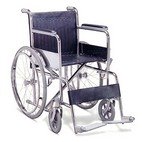
My options were either to take the public disability transit bus (TransHelp) to some clinic in the community right after work or to find a clinic close enough to work that I could motor over with my wheelchair right after work eliminating at least one, often lengthy wait or bus ride there and home again afterwards. Although grateful for the bus service offered the wait and trips often add 2 hours to my 8 hour workday. With an hour of physiotherapy twice a week, my day away from home frequently comes closer to 12 hours. A long time to sit!
I did find a private/community physiotherapy clinic in a ‘Professional Building’ across the hospital parking lot and decided to give them a try if for nothing more than convenience. Convenience in not having to take another bus trip however wheelchair navigation to the building had me crossing a busy roadway at the end of shift with hospital employees eager to leave the grounds. Crossing a torn up parking lot in the midst of renovation the professional building has a narrow ramp and double actuated swing doors leading into the foyer. Inside the six story building, the two public elevators are so small that they will accommodate my chair and perhaps two other persons. The chair can barely turn around inside the elevator cab. One floor down (basement) the physiotherapy clinic does not have an automatic door opener and I find it a struggle to enter the corner of the waiting room with chairs lining the walls at right angles along both sides. (I usually end up taking a chair or two with me as I enter!)
It was always my fear that in spite of the claims of “redundancy”, the private community clinics might not be able to provide the therapy and expertise that can be offered in a hospital setting. Right away I notice that much of the equipment that was instrumental in freeing me from having to be hoisted out of a bed/chair with a lift was nowhere to be seen. No tilt tables, no sit-to-stand units, no parallel bars - not even an aluminum frame walker was to be found. While a hospital physio clinic has to be prepared to offer therapy to traumatic spinal cord injuries, brain injuries, strokes and such, the private clinic seems to concentrate on jocks who have sports related injuries, minor automobile & workplace related injuries and perhaps women who have fallen off of their high-heel shoes. Clientele is different so supporting equipment and expertise is different.
After an initial assessment, the physiotherapist thought she could assist me in the goals I had set and we mutually decided to give it a try. I would come over after work about twice a week as our schedules permitted.
The physiotherapy clinic rented a frame walker for my use (as my own would be too cumbersome to bring along) and therapy began in mid-October. We shall see…
* * *
Due to government regulations, the private physiotherapy clinic is not allowed to bill my private insurance company directly for services rendered. Patient confidentiality or some other such nonsense. Unlike the hospital physiotherapy clinic which submitted claims on by behalf, I must pay the private physiotherapy clinic for each session, accumulate the receipts for whatever time I determine, then submit the invoices personally (by mail) for reimbursement at yet a later date. Does make a dent in the credit card balance prior to reimbursement.
* * *
(2) Private/Self Pay Clients - Community hospital’s mandates were originally to provide medical services to all residents of a particular community, often in one integrated and convenient location. These services were offered to both ‘Inpatients’ and ‘Outpatients’ covered under the government health plan. For extended, additional or elective therapy covered by one’s private insurance provider, or out of one’s own pocket, an additional branch of the department might cover these ‘Private/Self Pay’ outpatient clients.
(3) O.H.I.P. - Ontario Hospital Insurance Plan - our provinces government funded social health insurance. My original hospital stay, surgery, physiotherapy and just about everything ‘in hospital’ was covered by the government plan. Once I had been patched up and discharged, I was entitled to limited physiotherapy on the government plan, or additional continuing physiotherapy as my private insurance permitted. My good fortune was that I was entitled to unlimited physiotherapy in the plan my employer had negotiated with it’s private insurance carrier.
